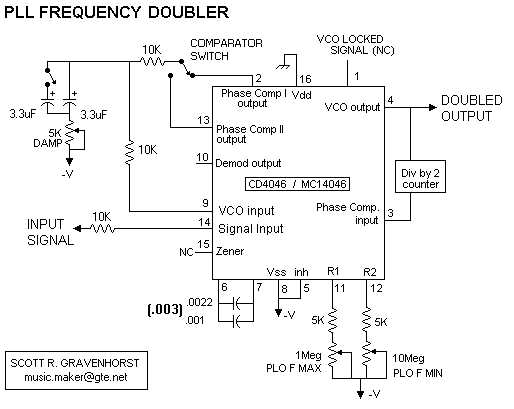
To generate a signal with a frequency that is a multiple of the input, a combination of nonlinear components such as diodes or transistors is typically used. These elements create harmonics that can be filtered and processed to achieve the desired frequency output. The primary focus is on selecting the right components and understanding how to manage the interaction between them to produce stable results.
The key step in constructing such a setup involves selecting a proper oscillator for generating the base signal. Once the initial frequency is established, various techniques like the use of a phase-locked loop (PLL) or diode mixers can be employed to generate higher harmonics. By filtering out the unwanted frequencies, the final output can be tailored to specific needs.
Pay close attention to the load impedance, as this can influence the efficiency of the process. Proper grounding and shielding also play a critical role in minimizing unwanted interference and ensuring that the final signal remains clean. The design of the filters will also dictate how effectively the harmonics can be isolated from the primary frequency.
Frequency Multiplier Circuit Diagram
To construct a reliable signal generator that produces an output at a higher harmonic of the input, it’s important to use a series of carefully selected components. A basic design typically incorporates nonlinear devices, such as diodes or transistors, to generate harmonics. These harmonics can be filtered, allowing you to isolate the desired higher frequencies while discarding the unwanted ones.
The first stage of the process begins with a stable oscillator, which generates a low-frequency signal. The next step involves choosing the nonlinear components that will generate the desired higher harmonics. These components are crucial, as they create the necessary distortion to produce multiples of the original signal.
A well-designed filtering network is necessary to separate the desired harmonics from the noise generated in the process. Band-pass filters are commonly used in these circuits, allowing only the desired frequency and its harmonics to pass through. The filter should be designed carefully to ensure that unwanted signals are effectively removed without affecting the output quality.
The oscillator used in such a design typically operates in the range of lower frequencies, such as in the kilohertz (kHz) or megahertz (MHz) ranges. Depending on the desired outcome, components like voltage-controlled oscillators (VCOs) can be used, as they offer flexibility in controlling the frequency. These components allow you to adjust the output frequency according to the specific needs of your application.
When working with these setups, it’s essential to pay attention to impedance matching. Mismatched impedance can lead to inefficient signal transmission, causing distortion or loss of power. Ensuring that the components are properly matched helps maintain signal integrity and minimizes signal degradation.
Another critical aspect of these circuits is power supply management. Providing a clean and stable power source is crucial to the reliability of the system. Power fluctuations can lead to instability in the output, which is undesirable for high-precision applications. Using dedicated voltage regulators and ensuring proper grounding can help mitigate these issues.
Lastly, shielding and grounding are often overlooked but are vital to the overall performance of the system. Electromagnetic interference (EMI) can severely affect signal quality, especially at higher frequencies. Proper grounding and shielding techniques, including using metal enclosures and ferrite beads, will minimize the risk of EMI and improve the performance of the entire setup.
How to Design a Frequency Multiplier Circuit Using Diodes
To design a signal generator that can generate harmonics of a base signal, begin by selecting appropriate diodes. Diodes such as Schottky or Germanium diodes are well-suited for nonlinear operation, which is critical for generating higher-order harmonics. In the design, connect the diodes in a series or parallel configuration to introduce the necessary distortion to the input signal. This will create the odd or even harmonics that are essential for frequency multiplication.
Next, incorporate a filter circuit to isolate the desired harmonic frequencies. A band-pass filter is ideal for this application, as it allows only the intended harmonic and its nearby frequencies to pass through. The filter should be carefully tuned to ensure it rejects unwanted frequencies and allows for a clean output. Proper matching between the input signal and the filter is crucial for achieving the desired level of performance.
Finally, power supply considerations are critical in this design. Ensure that the diodes receive a stable voltage for consistent operation. Power fluctuations can affect the performance of the multiplier. Additionally, proper grounding and shielding are necessary to prevent electromagnetic interference (EMI) from distorting the output signal. Using a stable power supply and employing good grounding techniques will enhance the stability and efficiency of the entire setup.