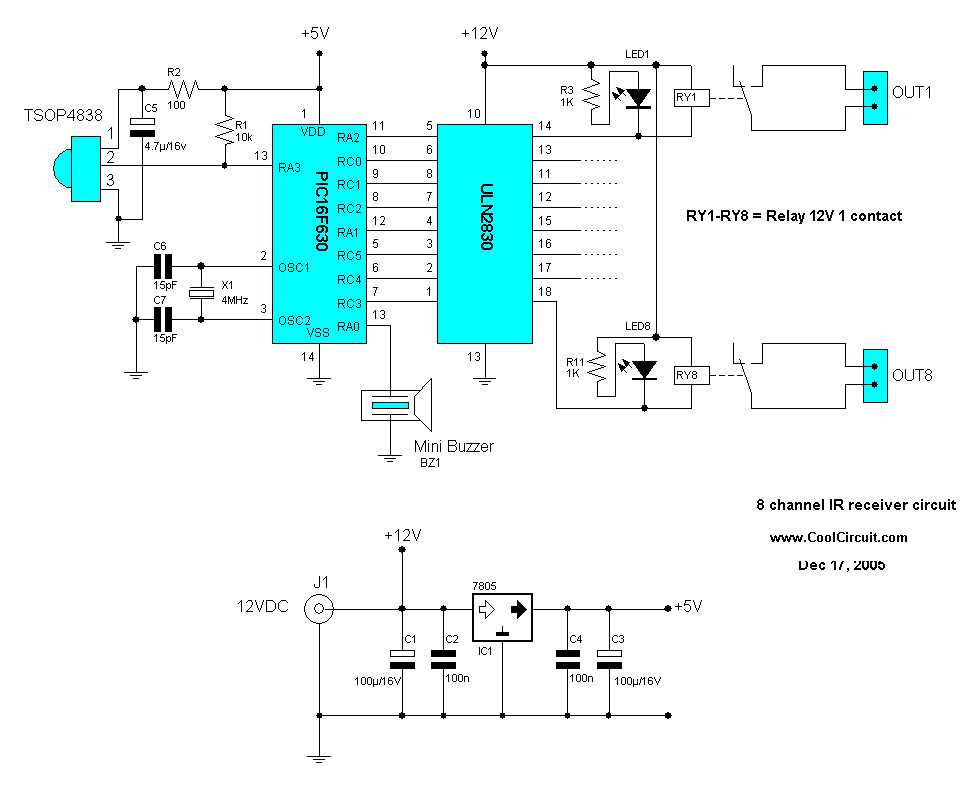
Start by selecting an appropriate emitter diode for sending signals. Ensure the LED type matches the wavelength required by your application. For home entertainment or simple sensor-based systems, common infrared LEDs should work without issues.
The sensor used for receiving signals must be sensitive to the same wavelength emitted by your diode. A typical photodiode or phototransistor can be used effectively. These components detect modulated infrared light from the emitter, allowing the system to respond appropriately.
Ensure both the emitter and sensor are connected to the correct voltage levels as specified by their datasheets. For simple setups, using a 5V power supply is typical, but ensure that each component can tolerate the voltage and current provided.
Next, connect the components with minimal resistance. Proper placement is key to ensuring maximum efficiency. Ensure the emitter is positioned where the receiving sensor can clearly detect the signal, with no obstructions in between.
Test the setup by activating the emitter. Check if the receiver detects the signal by observing its response. For some systems, a simple light indication or voltage change can confirm that communication is successful.
IR Communication Setup Guide
Start by selecting an infrared LED with a suitable wavelength, typically 850-950 nm. These diodes emit light that can be modulated to carry data to other devices. Ensure the LED is rated for the required voltage, typically 5V or 12V, based on your project’s specifications.
Next, connect the LED to a resistor to limit the current. The value of the resistor should be calculated based on the LED’s forward voltage and the desired current. For a standard 5mm infrared LED, a resistor of around 330 ohms will typically suffice when operating at 5V.
The receiver component should be chosen based on the frequency of the signal being sent. Most receivers use photodiodes or phototransistors that are sensitive to infrared light at specific wavelengths. The receiver should be positioned in such a way that it can detect the signal from the emitter directly, without obstructions.
Ensure that both the emitter and receiver are connected to the same power supply to maintain consistent voltage. A 5V DC power supply is common for most basic IR systems. Verify that the power ratings of all components match the supply to avoid overheating or damage.
Building the Infrared Communication Setup
Wire the emitter to a microcontroller pin that can send modulated signals, often through a simple program that controls the LED’s on/off cycles at a specific frequency. This frequency determines how data will be encoded. Common modulating frequencies include 38 kHz, which is standard for many IR communication systems.
On the receiving end, connect the photodiode to another microcontroller pin, which will be used to detect the modulated light signal. Use a signal decoder in the microcontroller code to interpret the incoming modulated data and trigger appropriate responses, such as turning on lights or sending information to other devices.
How to Select the Right Components for an IR Transmission System
Choose an infrared LED with a wavelength that matches your target receiver. Typically, a wavelength between 850 nm and 950 nm works best for most devices. Ensure the LED can handle the voltage required by your power supply, usually 5V or 12V.
Pick a current-limiting resistor that matches the LED’s specifications. For a 5V system with a 1.5V forward voltage LED, calculate the resistor value using Ohm’s Law: R = (V_supply – V_f) / I. For example, a 330-ohm resistor is often suitable for a 20mA current.
For signal modulation, use a microcontroller or dedicated oscillator that can generate a stable frequency for the IR LED. Common frequencies include 38 kHz, which is compatible with most IR receivers. The modulator should be able to toggle the LED on and off at this frequency.
Finally, ensure your power supply is stable and provides the correct voltage for both the emitter and control components. A typical setup uses a 5V DC power supply, but always verify the current ratings of all connected components to prevent overheating or damage.