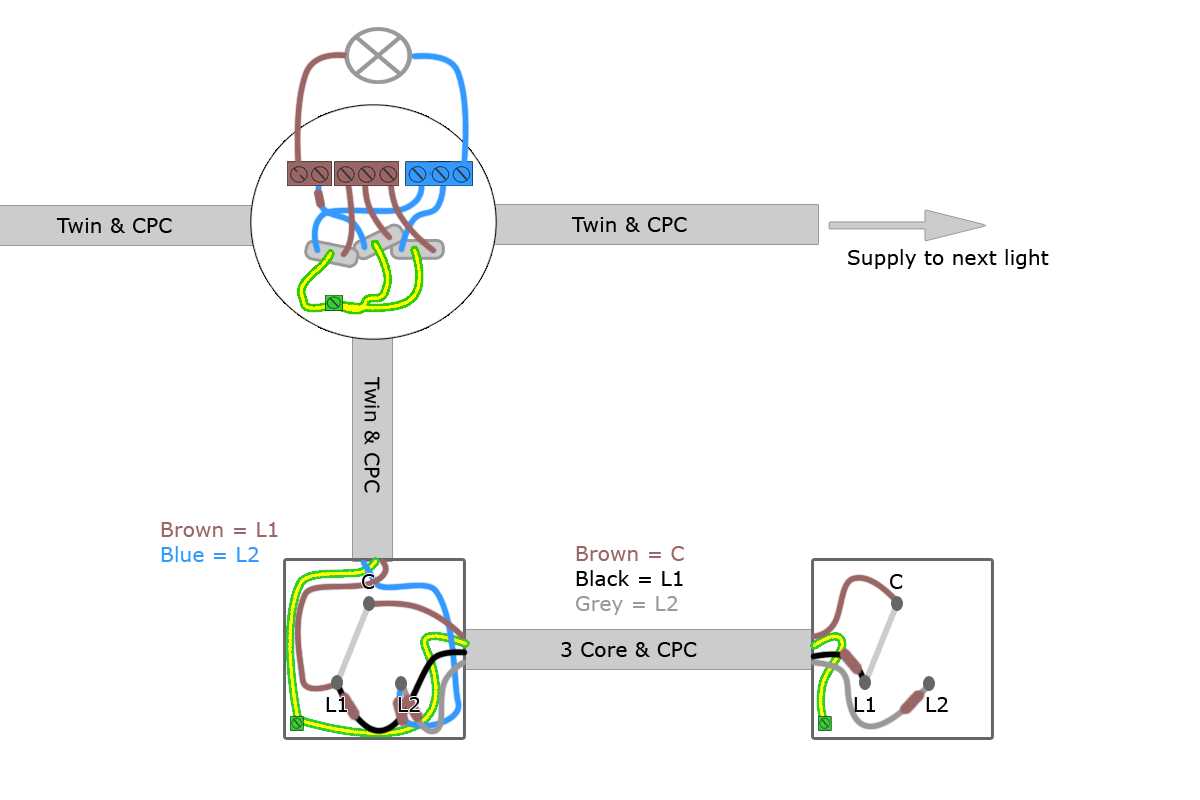
Connect the incoming phase conductor to the common terminal of the first wall control unit and link both devices using two traveler conductors. This arrangement allows a single luminaire to be controlled from separate positions such as opposite ends of a hallway or the top and bottom of a staircase. The load conductor runs from the common terminal of the second control unit directly to the light fixture.
Each control unit contains three terminals: one common contact and two traveler contacts. The common contact on the first unit receives the live supply from the distribution panel, while the common contact on the second unit sends power toward the lamp. The traveler conductors create alternate paths between the devices, allowing the light state to change whenever either control lever changes position.
Use a three-core cable between the wall devices. Typical conductor colors include brown or black for the phase input, gray and black (or red and yellow depending on region) for the travelers, and blue for the neutral conductor that runs directly to the luminaire without passing through the control units. The protective earth conductor must connect to the metal box or fixture housing.
Mark terminals clearly before connecting conductors. Reversing the traveler conductors does not break functionality, yet placing the phase wire on a traveler terminal instead of the common contact causes the lamp to remain constantly energized. A voltage tester helps identify the incoming live conductor before completing the connection layout.
Two Way Switch Wiring Diagram With Traveler Wires and Terminal Connection Layout
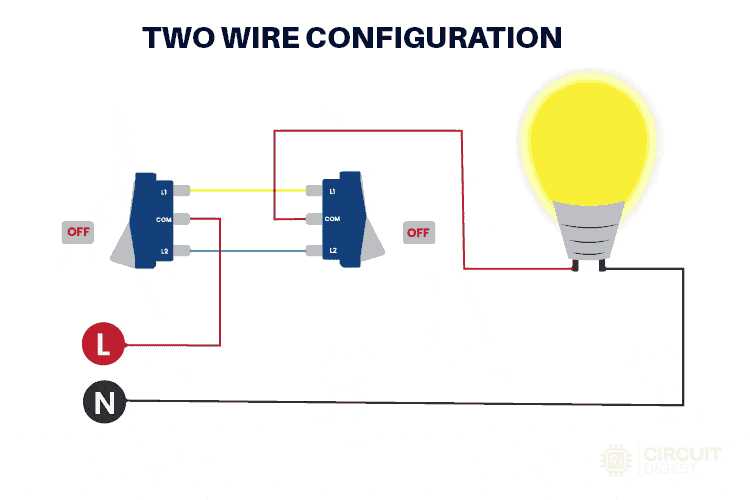
Connect the incoming live conductor to the common terminal of the first wall control unit and run two traveler conductors between both control devices. The outgoing conductor from the common contact of the second unit leads to the light fixture. This layout allows the lamp to change state from either location by redirecting current through one of the traveler paths.
Traveler conductor routing
Use a three-core cable between the wall devices so both traveler conductors remain in the same sheath. Typical color combinations include black and gray or red and yellow depending on regional standards. Each traveler attaches to the paired traveler terminals on both control units. These conductors alternate the active path whenever the lever position changes.
The common contact on the first device receives the phase conductor from the distribution panel. The common contact on the second device sends power to the luminaire. Neutral runs directly from the supply to the lamp without passing through either wall control unit, while the protective earth conductor connects to metal mounting boxes and fixture housings.
Terminal layout identification
Locate the terminal marked COM, L, or a darker screw color; this marks the common contact. The remaining two terminals serve as traveler connections. Reversing traveler conductors does not affect operation, yet placing the supply conductor on a traveler terminal causes unpredictable lamp behavior or constant illumination.
Terminal Identification on Two Way Switch Including Common and Traveler Contacts
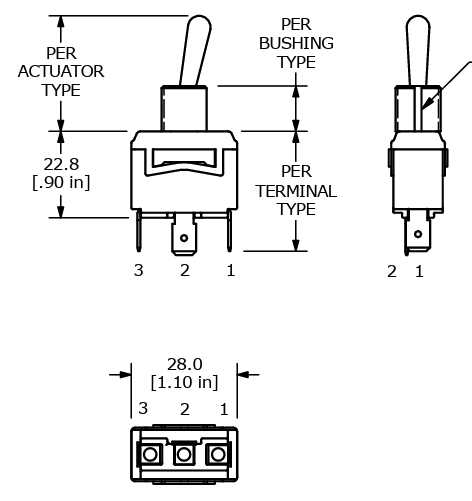
Locate the common terminal first before attaching any conductor. This contact usually carries a marking such as COM, L, or a darker screw color compared with the remaining terminals. The phase supply connects to this point on the first wall control device, while the common contact on the second unit routes current toward the lamp.
Recognizing traveler contacts
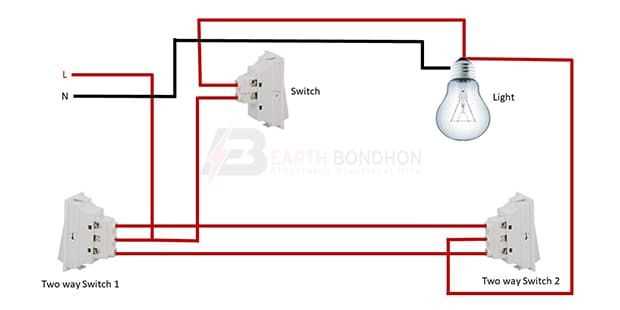
The remaining two terminals operate as traveler contacts. These points transfer current between both control devices through paired conductors. Each traveler terminal on the first device links directly to the matching terminal on the second unit using a dedicated conductor inside a three-core cable.
Traveler contacts usually appear with identical screw colors such as brass or silver. Their symmetrical placement on the rear of the device helps distinguish them from the single common terminal. Manufacturers often place them on one side of the body while the common contact sits alone on the opposite side.
Terminal labeling patterns
Manufacturers use several marking systems. Typical examples include:
COM – common contact receiving phase or sending power to the lamp
L – live conductor connection point
1 and 2 – traveler terminals forming alternate paths between control devices
Incorrect placement of the phase conductor on a traveler terminal leads to unstable operation where the lamp responds only from one location or remains energized. A voltage tester helps identify the incoming live conductor before attachment.
Check the rear housing of the device for molded arrows or printed contact labels. These indicators clarify terminal function and prevent confusion during installation inside crowded wall boxes.