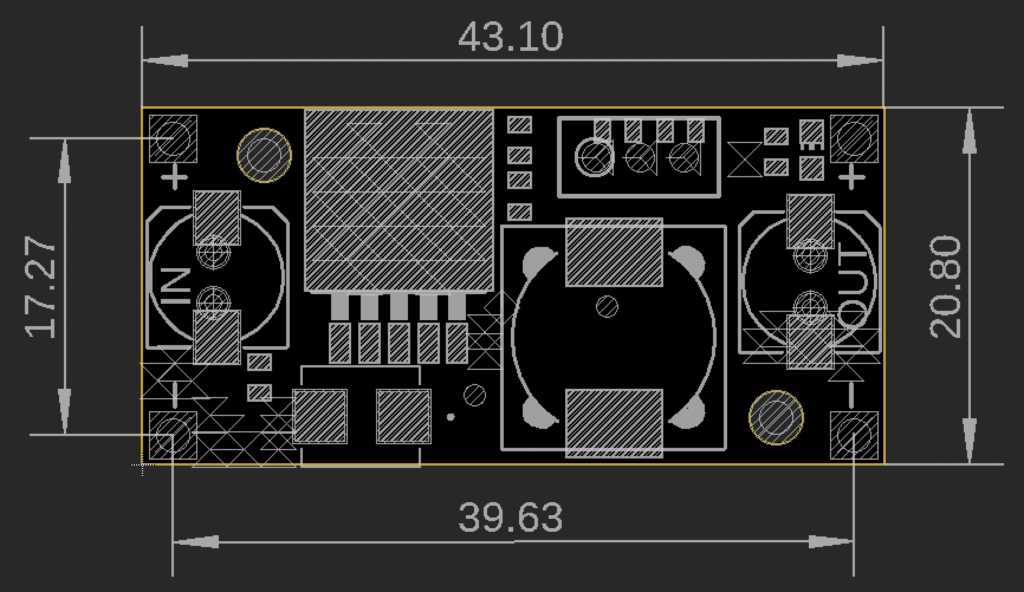
Optimize your power supply by integrating a step-down module capable of handling inputs up to 40V and delivering stable outputs between 1.25V and 37V. This setup minimizes thermal losses and provides consistent current delivery for sensitive electronics. Using a synchronous switch with an inductor rated for at least 33µH ensures smooth voltage transition and reduced ripple, critical for microcontroller and sensor applications.
Stability enhancements can be achieved by adding a low ESR capacitor on the output side, ideally in the range of 470µF to 1000µF, paired with a small ceramic bypass of 0.1µF. This combination suppresses high-frequency oscillations and maintains output precision under varying load conditions. Adjusting the feedback resistor network allows fine-tuning of the output voltage to within 0.1V accuracy, making it suitable for battery-powered devices or lab testing setups.
Thermal management should not be overlooked. Mounting the module on a heat-dissipating board or using a small heatsink for the switching IC helps maintain efficiency above 85% under continuous load. Positioning the inductor and input capacitor close to the switching element reduces parasitic resistance and prevents voltage dips during transient loads. Following these practical wiring and component guidelines ensures a compact, reliable, and high-performance step-down voltage solution.
DC-DC Step-Down Module Layout
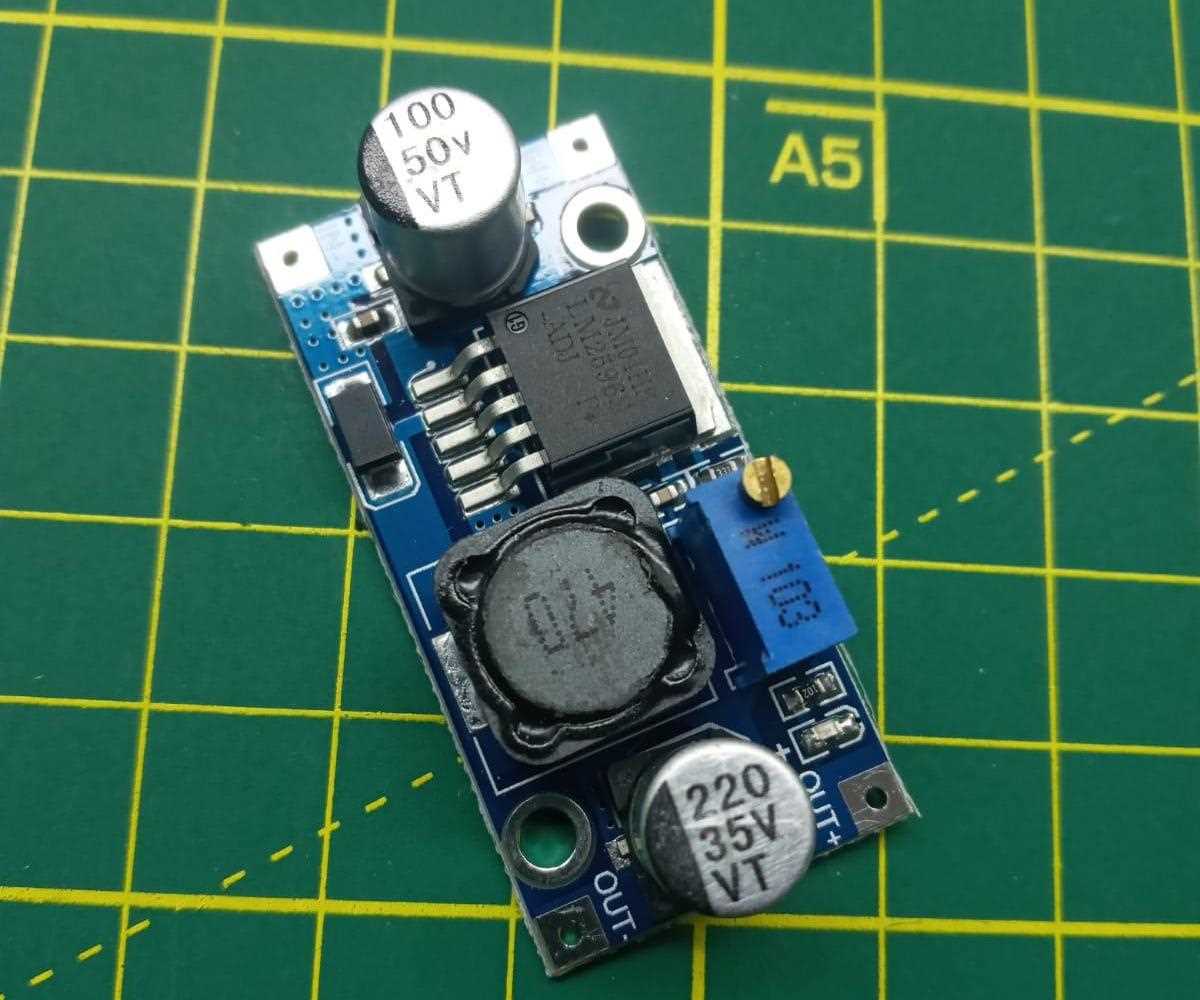
For stable voltage reduction from a 12V source to 5V, position the inductor close to the switching element and output capacitor to minimize voltage spikes. A 330µH inductor with a current rating above 2A ensures smooth current flow without saturation.
Place a Schottky diode with a low forward voltage drop directly across the output to improve response during load transients. Choose one rated at least 3A and with reverse voltage exceeding the input supply by 50%.
Use ceramic capacitors of 100µF at both input and output terminals to suppress high-frequency noise. Tantalum capacitors can supplement them to handle sudden load changes, preventing output dips.
Feedback and Regulation
Connect the adjustable resistor network from the output to the feedback pin to fine-tune the output voltage. Resistors with 1% tolerance maintain voltage within ±0.05V under varying loads. Keep the feedback traces short and away from switching nodes to avoid interference.
Include a small 0.1µF ceramic capacitor between the feedback node and ground to stabilize the control loop. This prevents oscillations at frequencies above 100kHz and improves transient response.
Heat dissipation is critical. Mount the switching module on a PCB with a thermal pad beneath the regulator, and use copper pours on both sides to reduce temperature rise above 70°C under continuous 2A load.
Finally, add a fuse rated slightly above the expected maximum load and a series resistor at the input to limit inrush current. This ensures the module survives sudden short circuits or voltage surges without damaging components.
Selecting Input and Output Capacitors for Stable Voltage
Use a low-ESR electrolytic capacitor of 220 µF to 470 µF at the input side rated at least 1.5 times higher than the maximum supply voltage. This reduces voltage ripple caused by sudden current draws and protects the upstream power source from transient spikes. Complement it with a 0.1 µF ceramic capacitor placed close to the control chip’s pins for high-frequency noise suppression.
For the output, combine a 470 µF to 1000 µF aluminum electrolytic capacitor with a 0.22 µF to 1 µF ceramic component in parallel. The electrolytic handles bulk energy storage, while the ceramic suppresses high-frequency oscillations. Ensure the voltage rating exceeds the target output by 20–30%, and check ESR values remain below 0.1 Ω to maintain loop stability under varying loads.
When arranging capacitors, position the input capacitor within 5 mm of the input terminals to minimize trace inductance. Similarly, place the output pair as close to the regulator terminals as possible. For designs expecting rapid load transients, consider adding an extra 100 µF low-ESR tantalum capacitor at the output. This combination keeps voltage deviations under 50 mV even during abrupt current changes.