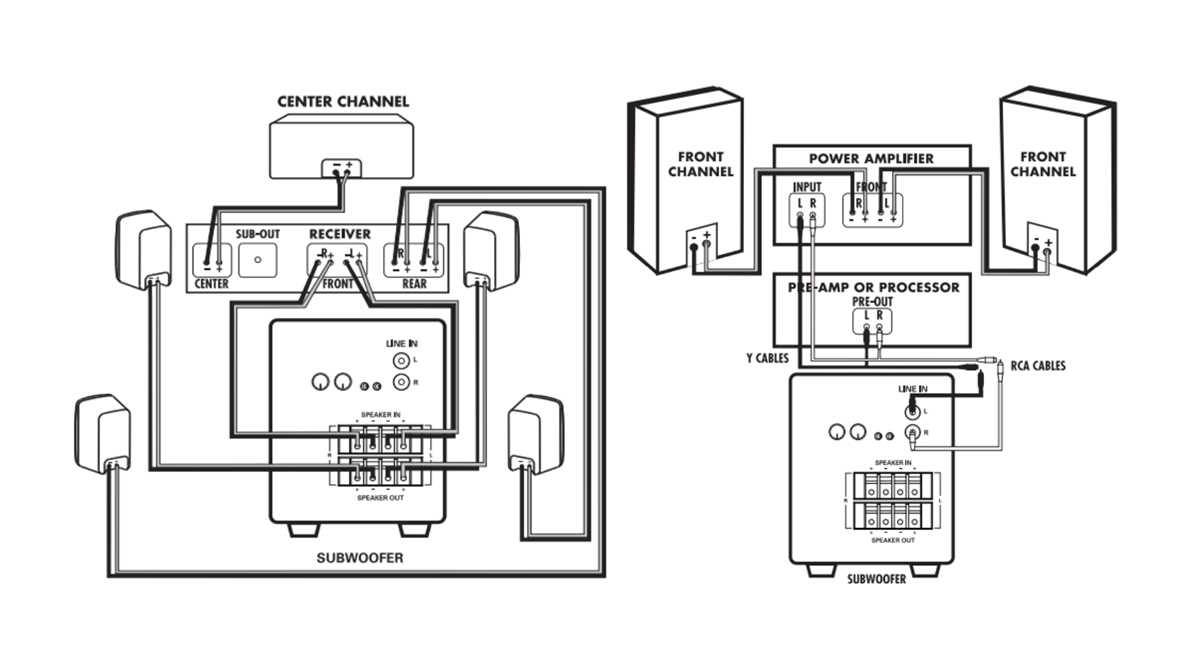
To successfully link a subwoofer to an audio amplifier, begin by determining the power requirements of both components. Ensure that the amplifier provides adequate power to drive the subwoofer without overloading either unit. Check the impedance of the subwoofer and match it to the output rating of the amplifier for optimal performance.
Next, use proper gauge speaker wire for the connections. The wire should be thick enough to handle the current without causing significant resistance or power loss. Connect the positive and negative terminals of the amplifier to the corresponding terminals on the subwoofer, ensuring tight connections to avoid signal loss or distortion.
Finally, verify the ground connection. A stable ground connection helps prevent electrical noise that could interfere with the sound quality. Place the ground wire as close to the amplifier’s power source as possible and securely attach it to a metal part of the vehicle’s frame or other grounded structure.
Connecting Audio Components for Maximum Output
To ensure optimal audio performance, it’s important to connect your speaker and power source correctly. First, choose a power amplifier that matches the impedance of the speaker you’re using. If the impedance is too high or too low, the system could either underperform or damage the components. Use appropriately rated cables for both the power and signal connections, ensuring minimal loss of sound quality.
The speaker wire should be connected securely to the amplifier’s output terminals, with the positive wire linking to the positive terminal and the negative wire to the negative terminal. Make sure the connections are tight to avoid any issues with signal transmission. Double-check that there are no loose wires that could create short circuits or distort the sound.
Finally, verify that the ground wire is properly connected to both the amplifier and the vehicle’s chassis (if applicable). A poor ground connection can lead to electrical noise and affect sound clarity. By taking these steps, you’ll guarantee a stable and high-quality audio setup for your system.
How to Connect a Subwoofer to an Amplifier
Start by selecting the appropriate speaker wire gauge for your setup. For most systems, 12-14 gauge wire is sufficient. Thicker wires are recommended for longer distances to reduce signal loss, while thinner ones are better for short connections.
Ensure that your amplifier’s output matches the impedance of the subwoofer. For example, a 4-ohm speaker should be paired with an amplifier capable of driving a 4-ohm load. If you are connecting multiple speakers, check if the amplifier can handle the total impedance.
Next, connect the positive (+) and negative (-) terminals on the amplifier to the corresponding terminals on the subwoofer. Double-check that the connections are secure and that no stray wires could cause a short circuit or interfere with the signal.
If your amplifier offers multiple speaker outputs, decide whether you want to use parallel or series wiring. Parallel wiring results in lower impedance, while series wiring increases it. Choose the method that matches the specifications of your amplifier and subwoofer.
Once the physical connections are made, adjust the amplifier’s settings to match the subwoofer’s characteristics. Set the crossover frequency and gain appropriately to avoid distortion and achieve a balanced sound. Ensure that the gain is not set too high, as this can cause clipping and damage to your components.