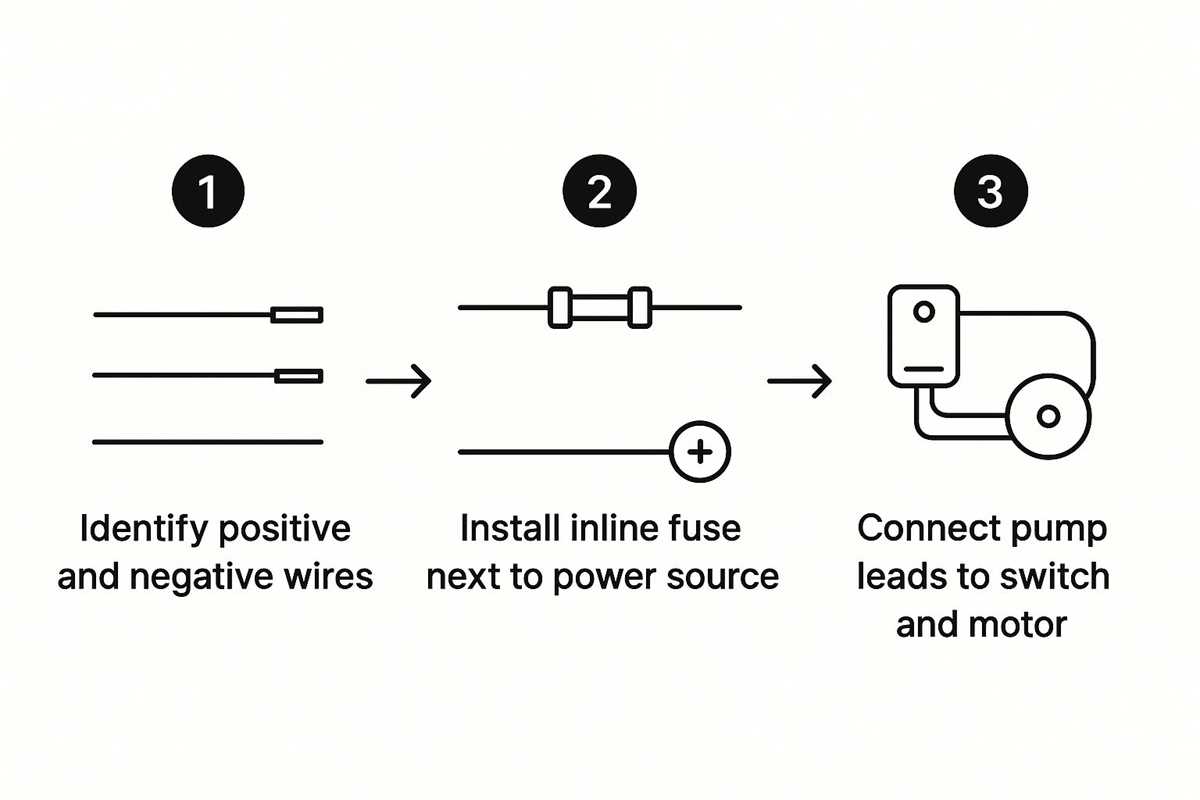
Connect the positive lead from the vessel battery to a fused line rated between 5A and 15A depending on motor capacity, then route it through a manual control switch before attaching it to the motor’s positive terminal. The negative lead should run directly from the motor return terminal to the battery ground point or the boat’s common grounding bus.
Most small marine drainage motors operate on 12-volt DC systems and use two conductors only: one for power delivery and one for return current. Manufacturers typically mark the positive lead in brown or brown with stripe, while the return lead is often black. Confirm color coding with the device manual because variations exist between brands.
Install the inline fuse within 7 inches (about 18 cm) of the battery terminal. This placement reduces risk of short circuits along the power lead running through the hull or electrical panel. Choose marine-grade conductors with tinned copper strands and insulation rated for moisture exposure.
Keep the power path short and route conductors above the lowest interior points of the hull. Secure them every 40–50 cm with corrosion-resistant clips. This prevents vibration damage and limits contact with standing water, oil residue, or moving mechanical parts inside the vessel.
A simple two-conductor setup works for most small craft drainage systems. With a fused positive line, a direct ground return, and a sealed control switch, the motor activates instantly and removes accumulated water from the lowest compartment of the boat without complex electrical routing.
2 Wire Bilge Pump Wiring Diagram With Battery Switch and Fuse Connection Guide
Place an inline fuse on the positive conductor leaving the 12-volt battery and mount it within 15–18 cm of the battery terminal. Select a fuse rated slightly above the motor draw; for example, a small marine drainage unit rated at 3–5 amps should use a 7.5A fuse. This protection stops current flow during a short circuit before insulation melts or connectors overheat.
Route the positive conductor from the fuse to a waterproof control switch located on the console or electrical panel. From the switch output, run the line directly to the positive terminal of the drainage motor. The return conductor should connect from the motor’s negative terminal to the vessel grounding bus or directly to the battery negative post.
Battery switch routing
If the boat uses a main battery selector (OFF–1–2–BOTH), attach the fused positive lead to the terminal that remains active during normal operation. This allows the drainage unit to run whenever the selected battery bank supplies power. Avoid connecting the device ahead of the selector unless the goal is continuous operation regardless of switch position.
Use marine-grade conductors sized 16 AWG for loads under 10A and 14 AWG for runs longer than 4 meters. Tinned copper strands resist corrosion inside humid compartments. Seal all crimp connectors with adhesive heat-shrink tubing and mount them above the lowest hull surfaces to reduce exposure to standing water.
Connection layout example
A typical two-conductor layout follows this order: battery positive → inline fuse → dashboard switch → motor positive terminal, while the return path runs motor negative → grounding bus → battery negative. Secure conductors every 40 cm with stainless clips and keep them separated from fuel lines, moving shafts, and sharp fiberglass edges.
Wire color identification and polarity in a 2 wire bilge pump circuit
Check conductor colors before connecting the drainage motor to the 12-volt supply. In most marine installations the positive lead is brown or brown with a stripe, while the return line is black. Attach the brown lead to the switched battery positive terminal and connect the black lead to the negative bus or battery ground post.
Confirm polarity with a multimeter set to DC voltage. Touch the red probe to the suspected positive conductor and the black probe to the battery negative terminal. A reading near 12.6 volts on a charged marine battery indicates correct polarity. Reverse probe placement will show a negative value, which signals that the conductor roles were swapped.
Common marine color standards
Many boat manufacturers follow ABYC color practices for low-voltage circuits. Brown typically marks equipment used for water removal from the lowest hull section, black indicates ground return, and red is reserved for direct battery feeds. During replacement or repair, maintain the same color pattern so future troubleshooting remains simple and consistent across the vessel’s electrical system.
Handling mismatched colors
If the installed motor uses different insulation colors, mark each conductor with heat-shrink labels or colored tape near the terminals. Leave at least 3–4 cm of visible marking at both ends of the cable path. This small step prevents reversed polarity during maintenance and avoids motor damage caused by incorrect battery connection.