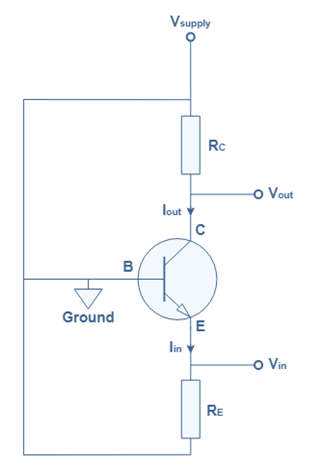
To analyze the functioning of an amplifier in an inverted configuration, first examine the placement of the input and output terminals. The input is applied to the emitter, while the output is taken from the collector. This simple yet effective setup is often used in applications requiring stable voltage amplification.
Pay attention to the components involved, especially the transistor. The role of the emitter, base, and collector must be understood in the context of signal flow. The base typically serves as the reference point, while the emitter controls the input signal, and the collector manages the amplified output.
When reading this schematic, focus on the relationships between the input and output signals. The input voltage is typically low, and as it passes through the transistor, it gets amplified, but with a phase inversion. This means the output signal is inverted compared to the input, which is a key characteristic of this configuration.
Next, it’s important to understand how the biasing network is arranged. The voltage divider or resistor network used in these setups determines the operating point of the transistor. Adjusting the biasing allows for fine-tuning of the amplification level, which is critical for ensuring linear response and avoiding distortion.
The collector resistor plays a significant role in determining the gain of the system. By adjusting this value, you can modify the amplification factor, making this configuration highly adaptable for different applications, such as signal processing or audio amplification.
In this setup, feedback mechanisms are often used to improve stability and linearity. These feedback loops ensure that the system remains predictable and does not distort the amplified signal. Understanding how these feedback paths interact with the main circuit will help you troubleshoot and optimize performance.
Lastly, this configuration is widely used in electronics where high voltage gain and impedance matching are required. Its simplicity and efficiency make it suitable for applications in radios, amplifiers, and even some power supplies, where small input signals need to be amplified with minimal complexity.
Understanding the Amplifier Configuration and Signal Flow
In this setup, the signal is applied to the emitter, and the output is taken from the collector. This creates an inverted signal at the output, meaning the phase of the amplified signal is flipped. This configuration is useful when the objective is to achieve a high voltage gain with minimal components.
The voltage gain in this arrangement is determined primarily by the collector resistor. The higher the resistance, the greater the voltage amplification. However, increasing the resistance too much can lead to instability and distortion in the output signal, so careful selection is key.
- Emitter resistor: Helps stabilize the operating point of the transistor and improves the overall linearity of the amplifier.
- Collector resistor: Affects the gain and must be sized appropriately for the desired amplification level.
- Biasing network: Ensures the transistor operates in the active region, providing consistent amplification.
This configuration is commonly used in high-frequency applications, where the simplicity and direct signal amplification are crucial. It is often seen in RF amplifiers and other electronic systems where signal inversion is acceptable and high gain is required.
How to Identify Components in a Common Base Circuit
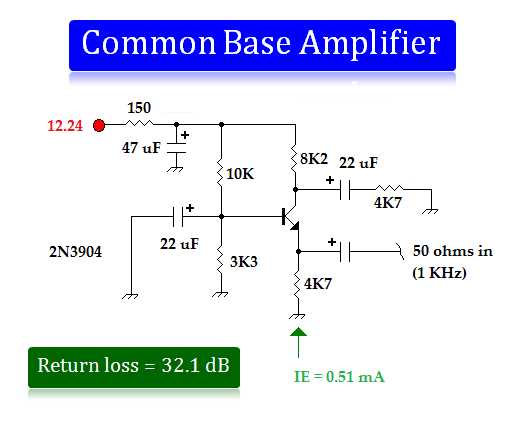
Start by identifying the transistor, which is the main active component in this setup. The transistor will typically be shown as a three-legged symbol with one leg for the emitter, one for the base, and one for the collector. Each leg plays a different role in the amplification process, so recognizing them is the first step in understanding the circuit.
Next, look for resistors that are often connected to the emitter, collector, or base. These components are used to set the operating point of the transistor and control current flow. The value of the resistors directly impacts the overall gain of the amplifier, so knowing their positions is important for determining the circuit’s behavior.
Identifying Passive Components
Capacitors are also a key part of these setups. These components are used for coupling or decoupling signals between stages. Look for capacitors placed between the input and the base or between the output and the collector. They ensure proper signal flow and help prevent DC voltage from reaching the following stage, which could distort the output.
Biasing Network and Other Components
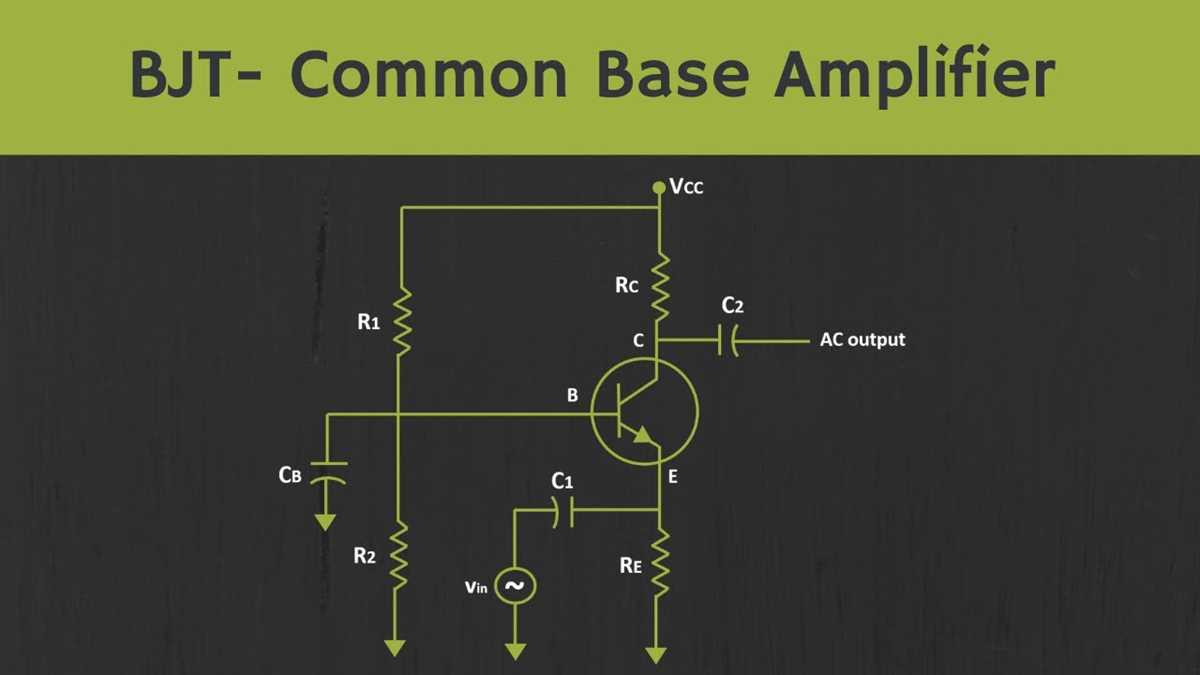
The biasing network is usually composed of resistors and sometimes capacitors to stabilize the operating point of the transistor. Check for voltage divider networks typically located at the base to establish the proper bias voltage. This is important for ensuring that the transistor operates in its active region.
Next, verify the power supply connections. A DC voltage source is often connected to the collector through a load resistor, providing the necessary power to drive the transistor. Ensure that the power connections are clear to understand how energy is supplied to the system.
Additionally, pay attention to any feedback paths, which can be implemented using resistors or capacitors. Feedback loops are used to stabilize the circuit and ensure consistent performance. These can often be found between the output and the base or emitter, adjusting the gain dynamically.
Finally, look for any protection components such as diodes or fuses, which safeguard the circuit from voltage spikes or overloads. These components are important for the longevity and reliability of the circuit, especially when dealing with high-power or sensitive equipment.