Connect the inlet to the main supply line with a shut-off valve to allow precise regulation of flow. Installing a thermostatic control at this point ensures the liquid temperature remains stable under varying demand. Use high-quality connectors rated for at least 10 bar pressure to prevent leaks and corrosion over time.
Integrate a return pathway equipped with a balancing valve to maintain even distribution across multiple units. Measure the pressure differential across each branch to identify potential bottlenecks, and adjust accordingly. Stainless steel piping is recommended for loops with aggressive or mineral-rich fluids.
Include an expansion segment with an air separator to remove trapped gases that can reduce efficiency. Monitor the temperature gradient across the assembly with inline sensors to detect anomalies early. Insulating flexible hoses in critical sections minimizes heat loss and prevents condensation in cooler environments.
Position the pump downstream of the heat exchanger for consistent circulation. Choose a variable-speed model to adapt to fluctuating loads while conserving energy. Periodic flushing of the loop removes sediment buildup, extending the operational lifespan and ensuring uniform heat transfer.
Install a safety bypass with a pressure relief valve to protect the system from overpressure scenarios. Regularly inspect gaskets and seals, especially in high-temperature zones, to maintain system integrity. Flow meters at key points provide real-time data, allowing proactive adjustments and preventing uneven heating.
Radiator Circuit Blueprint
Connect the pump outlet directly to the inlet manifold using a 22 mm reinforced pipe for consistent flow. Avoid sharp bends to reduce pressure drops and maintain hydraulic balance.
Install a thermostatic valve on each branch to regulate temperature independently. Recommended setpoint is 70–75°C for residential heating loops.
Use a header with at least four ports if connecting multiple units. Ensure that flow meters are installed on each branch to monitor distribution and detect blockages early.
- Primary loop: 32 mm piping, minimum flow 0.8 L/s
- Secondary branches: 22 mm piping, flow 0.3–0.5 L/s per unit
- Air vents: automatic type at the highest points of each branch
- Safety relief: 3 bar pressure relief valve on the return line
Loop length should not exceed 25 meters without booster circulation. Beyond this, add a circulation pump in series to maintain uniform heat delivery.
Insulate all supply and return lines with 13 mm foam or fiberglass wrap to minimize thermal loss. Ensure joints are sealed with silicone or heat-resistant tape to prevent leaks.
Position the expansion tank above the highest unit in the layout. For a 100 L system, a 10 L diaphragm tank is sufficient to handle thermal expansion without overpressure.
How to Connect Valves in a Closed-Loop System
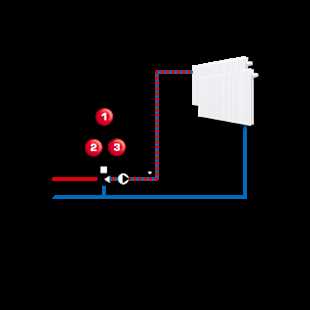
Install a thermostatic valve at the inlet of each heating panel and a lockshield valve at the outlet. Ensure the thermostatic valve is oriented toward the hot supply pipe, while the lockshield faces the return line. Use compression fittings with PTFE tape on threaded connections to prevent leaks, and maintain a consistent torque of 15–20 Nm for standard ½-inch valves.
Balance the loop by partially closing the lockshield valves starting from the furthest unit from the pump. Measure differential pressure with a manometer: aim for a 0.1–0.2 bar drop across each panel. Adjust incrementally, opening or closing ¼ turns, until flow is uniform. Avoid fully closing any lockshield valve, as it can create air pockets and reduce circulation efficiency.
Pipe Placement and Flow Optimization
Use horizontal feed pipes with a slight slope toward the return manifold to allow trapped air to escape naturally. Keep the distance between valves and manifolds under 300 mm to minimize pressure loss. For loops exceeding 20 m, add a secondary balancing loop or a differential pressure bypass to prevent over-pressurization at near-end units.