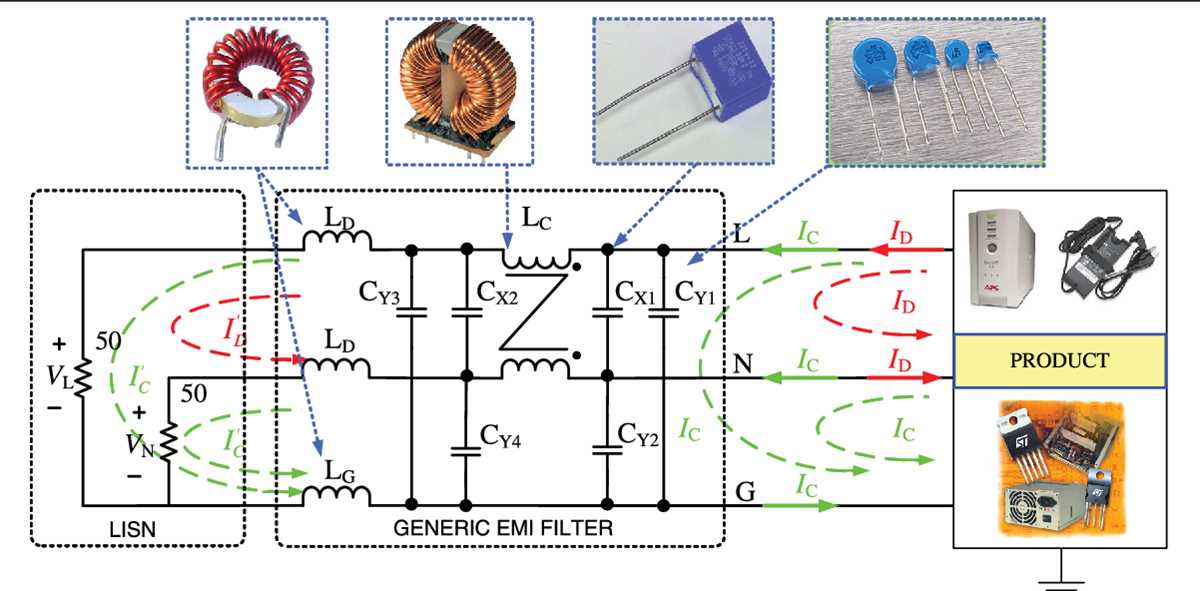
Use a combination of inductors and capacitors in a pi-network arrangement to minimize high-frequency interference on power lines. Placing a 10 µH inductor in series with the supply and pairing it with 0.1 µF ceramic capacitors to ground on both input and output terminals reduces unwanted transients above 1 MHz.
Pay attention to layout and grounding. Keep all connecting traces short and avoid loops that can act as antennas. A ground plane beneath the components significantly lowers radiated noise, improving the integrity of sensitive analog signals.
Adjust component values based on load characteristics. For low-current microcontroller boards, 4.7 µH series inductors combined with 0.01 µF to 0.1 µF capacitors are often sufficient. For high-power switching modules, consider 47 µH inductors with multiple parallel 1 µF X7R ceramics to handle higher ripple currents without resonant peaks.
Integrate common-mode suppression where possible. Using a toroidal core with bifilar windings can remove differential and common-mode disturbances simultaneously, preventing interference from propagating through the supply network.
Test under operational conditions. Measure voltage fluctuations with an oscilloscope while applying nominal load and injected noise. Fine-tuning component placement and values after real-world measurements ensures the design meets stringent electromagnetic performance requirements.
EMI Suppression Layout Blueprint
Use a combination of common-mode and differential-mode suppression components directly at the AC input to prevent high-frequency noise propagation. Opt for X2-rated capacitors across the line and Y2-rated capacitors to ground to maintain safety compliance with 250 VAC systems.
Inductors with ferrite cores should be wound with low DC resistance while providing at least 1 mH of impedance at 100 kHz. Avoid air-core coils in mains paths as they fail to suppress low-frequency transients effectively.
Component placement matters: position the series inductors as close as possible to the entry terminals, and place bypass capacitors near the load connection to minimize loop area. This reduces radiated interference in the surrounding PCB tracks.
Use a star-ground configuration for the protective earth to prevent circulating currents. Keep traces short and thick between suppression elements and mains connectors; this reduces voltage drops and preserves high-frequency attenuation.
Thermal and Mechanical Considerations
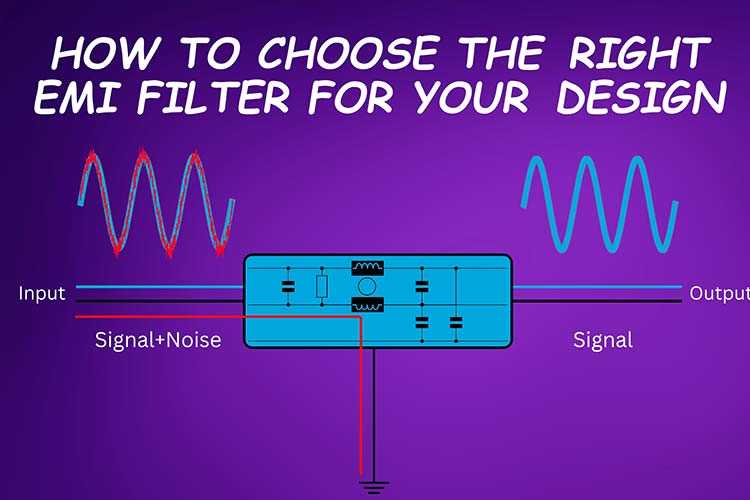
Ensure that the metal oxide varistors and inductors have sufficient clearance from heat-generating devices. Even a few millimeters of spacing improves reliability and prevents premature aging of polymer-based dielectric materials.
Testing should include both differential and common-mode impedance measurements. Verify insertion loss across 10 kHz–30 MHz to confirm attenuation meets regulatory requirements before finalizing the layout for production.
Choosing Capacitors and Inductors for EMI Suppression
Use ceramic capacitors with X7R or C0G dielectrics for bypassing high-frequency disturbances; values between 10 nF and 100 nF handle signals up to 100 MHz effectively.
Film capacitors such as polypropylene offer low dissipation factor for differential-mode attenuation; 0.01 µF to 1 µF ratings work well for audio and power line applications.
Inductors with ferrite cores should be selected based on saturation current above maximum load; typical inductance ranges from 10 µH to 1 mH for switching power converters.
Surface-mount multilayer inductors reduce parasitic capacitance; a quality factor (Q) between 30 and 80 ensures minimal insertion loss while suppressing unwanted harmonics.
For AC lines, choose common-mode chokes with winding ratio 1:1 and impedance exceeding 1 kΩ at 1 MHz; this blocks noise without excessive voltage drop.
Capacitors connected across signal lines benefit from self-resonant frequency above operating frequency; pick devices with SRF at least three times the highest signal component to prevent resonance peaks.
Shielded inductors limit radiated emissions; use models with metallic enclosure and high permeability core to confine magnetic flux and reduce coupling to nearby traces.
Combine multiple capacitor types in parallel–ceramic for high frequencies, film for low frequencies–to achieve broadband suppression; ensure voltage rating exceeds supply by at least 25 % to maintain reliability.