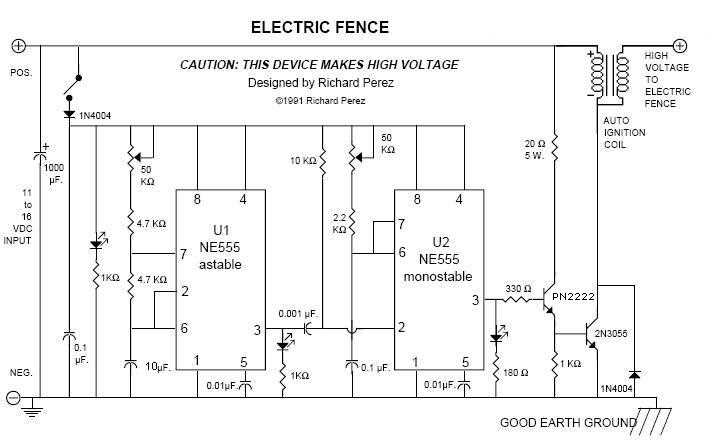
Use a pulse energizer unit that delivers short high-voltage bursts rather than continuous current. Typical units generate pulses between 4 kV and 10 kV with a duration of about 100–300 microseconds. This approach discourages animals or intruders while keeping average current extremely low.
The energizer normally operates from a 12V battery, solar module, or mains adapter. Inside the unit a timing oscillator drives a switching transistor or MOSFET. This stage feeds a step-up transformer that converts low voltage from the power source into high voltage bursts delivered to the perimeter conductor.
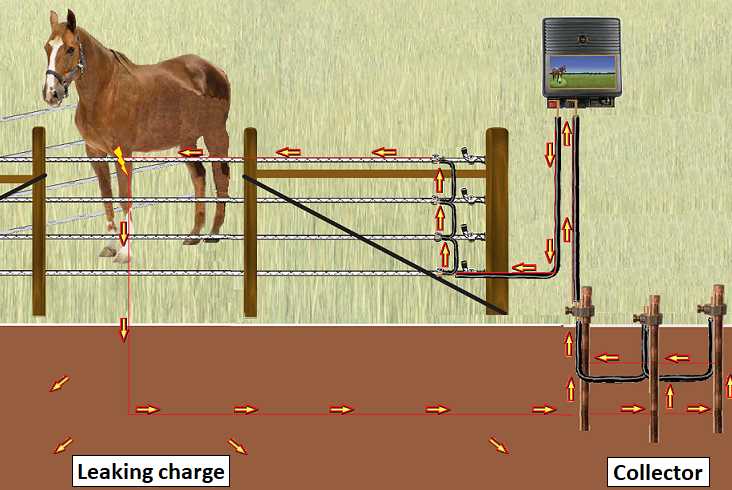
A practical layout connects the high-voltage output terminal to the perimeter wire while the second terminal goes to a ground rod driven at least 1 meter into moist soil. Galvanized steel rods or copper-clad stakes provide stable grounding. Poor soil contact lowers shock intensity and reduces barrier performance.
Spacing of support posts and insulators also affects system behavior. Install insulated mounts every 3–5 meters along the perimeter line. Keep the conductor elevated from soil and vegetation to prevent leakage. Grass or wet branches touching the wire absorb part of the pulse energy and weaken the deterrent signal.
Electric Fencing Circuit Diagram with Pulse Generator Transformer and Perimeter Wire Layout
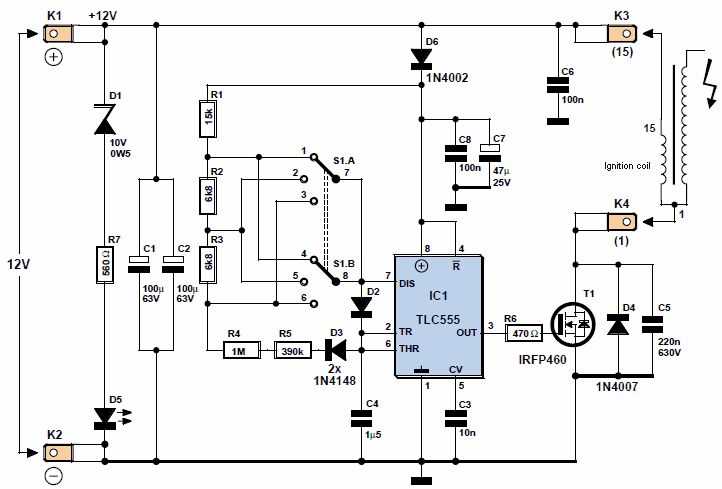
Install a pulse energizer that produces short high-voltage bursts rather than continuous output. A typical unit operates from a 12V battery or mains adapter and uses an oscillator stage built with a transistor or timer IC. The oscillator sends periodic switching signals to a power transistor that drives the primary coil of a step-up transformer. Each switching cycle creates a brief surge that the transformer raises to several kilovolts.
Main Power Unit Connections
The energizer enclosure normally contains the following parts:
- Timing oscillator producing pulses every 0.8–1.5 seconds
- Switching transistor or MOSFET controlling the transformer primary
- Step-up transformer producing 4 kV to 10 kV output bursts
- Capacitor bank that stores energy before each pulse
The high-voltage output terminal connects to the perimeter conductor stretched along insulated posts, while the second terminal attaches to a ground rod driven at least 1 meter into moist soil. Use ceramic or polymer insulators every 3–5 meters to prevent leakage to support posts. Maintain clear space around the line; wet vegetation touching the conductor absorbs pulse energy and lowers shock strength along the perimeter.
Electric Fence Pulse Generator Components and High Voltage Transformer Connections
Use a pulse energizer built around a timing oscillator, a switching transistor, an energy storage capacitor, and a step-up transformer. The oscillator produces a short trigger roughly every 1 second. Each trigger allows the stored energy inside the capacitor to discharge through the transformer primary coil.
The transformer converts low input voltage from a 12V battery or power adapter into short bursts reaching 4000 to 10000 volts. The primary winding connects to the switching transistor collector or drain, while the opposite side of the coil attaches to the supply line. When the transistor switches on, current flows through the primary and magnetic energy builds inside the core.
Pulse Generator Component Roles
The energizer unit normally includes several core parts:
Timing stage often built with a 555 timer or simple transistor oscillator that sets the pulse interval.
Storage capacitor typically between 100 µF and 470 µF rated above the supply voltage.
Power transistor or MOSFET controlling current flow through the transformer primary.
Step-up transformer raising the low voltage surge to high voltage output.
The secondary winding of the transformer connects directly to the perimeter conductor through a high-voltage output terminal. The second secondary lead connects to a grounding rod placed deep into moist soil. Each oscillator cycle releases stored energy into the transformer, producing a narrow high-voltage spike that travels along the perimeter line.
Keep transformer leads short and well insulated because output spikes exceed several kilovolts. Place the energizer enclosure away from moisture and route the high-voltage terminal through insulated feed-through connectors to prevent arcing inside the housing.