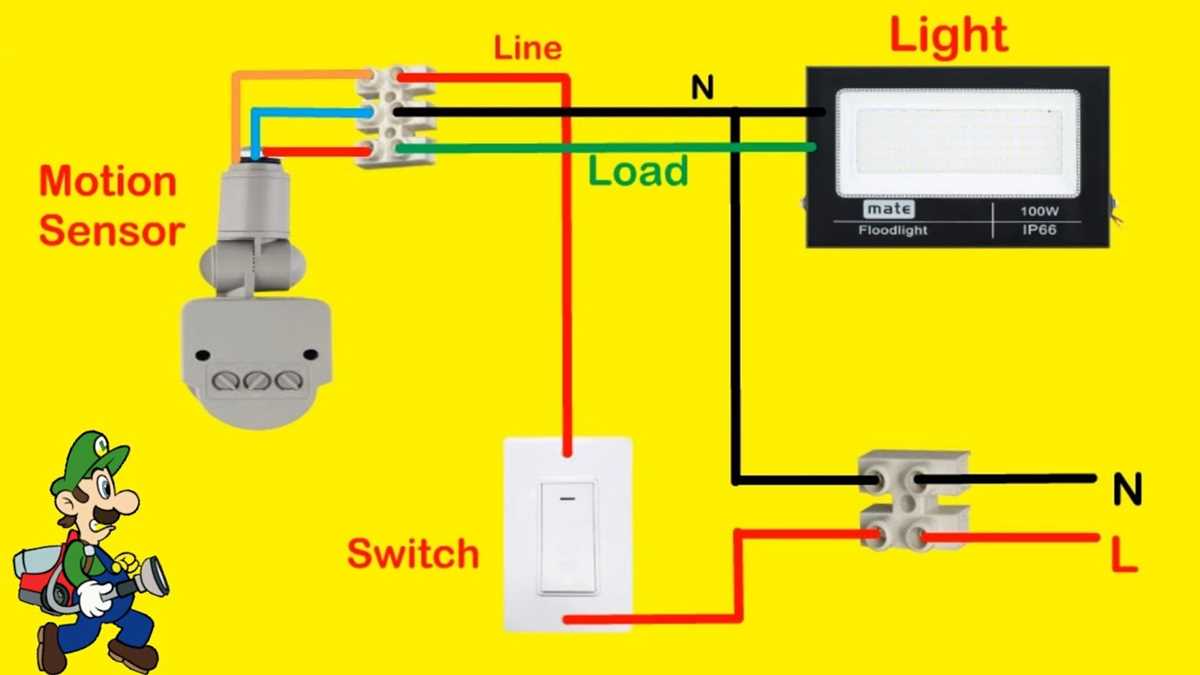
Connect the live line directly to the device’s input terminal while ensuring that the neutral and ground paths are secure and uninterrupted. Use 14-gauge wire for indoor installations and confirm that the breaker supports at least 15 amps to prevent overloads.
For multiple control locations, link the auxiliary terminals in parallel using stranded copper wire with clear labeling to avoid cross-connections. Ensure each connection is tightened to 12 lb-in torque to maintain stable contact and minimize voltage drop.
Verify the load capacity before final installation by checking the maximum amperage rating of connected lights or fans. Employ inline fuses or miniature circuit breakers where necessary to protect the system from short circuits and prevent device damage.
Adjust timing and detection parameters after energizing the system, monitoring response distance and activation speed. For rooms exceeding 25 feet in length, consider using an intermediate module to maintain consistent triggering without false activation.
3 Point Detection Device Connection and Setup
Connect the live conductor to the input terminal marked for line voltage and confirm that the neutral line is routed directly to the load. Use color-coded wires for each path to prevent accidental misconnection and ensure compliance with standard codes.
Attach the secondary control terminals in parallel for multi-location activation. Maintain a minimum spacing of 12 inches between each connection junction to reduce interference and signal feedback issues.
Secure all grounding points to the metal frame or grounding bus using ring terminals. Check continuity with a multimeter to guarantee less than 0.1 ohms resistance before energizing the system.
Install the load on the output terminal designated for switched power. Confirm the total amperage does not exceed 15 amps to prevent thermal stress and extend device longevity. For higher load applications, introduce a relay rated above 20 amps.
Timing and Sensitivity Adjustments
Adjust detection intervals using the rotary or digital adjustment knobs. For rooms over 20 feet in length, increase delay time to avoid premature deactivation. Verify motion coverage at multiple points to ensure uniform triggering.
Calibrate the device angle so the detection field covers the entire traffic area. Avoid placing the unit near reflective surfaces like mirrors or windows to reduce false triggers caused by reflected signals.
Label each conductor at junction points with heat-shrink markers or tags to simplify future maintenance. Keep terminals free of paint or debris to maintain secure contact and prevent arcing under load.
Test the complete installation by manually activating each control point, confirming that the load responds correctly. Observe the unit over several cycles to verify timing accuracy, consistent activation, and absence of false triggers.
Identifying Terminals and Preparing Electrical Lines
Start by clearly marking each terminal according to its function: line input, load output, and neutral connection. Use a multimeter to verify continuity and ensure that each terminal corresponds accurately to its designated circuit path before any conductors are attached.
Strip and prepare conductors to the recommended length of 6–8 millimeters and twist the strands tightly to prevent fraying. Route lines along a defined path, avoiding sharp bends and contact with metal edges, and secure them with cable clips to maintain stable connections and reduce mechanical stress during operation.