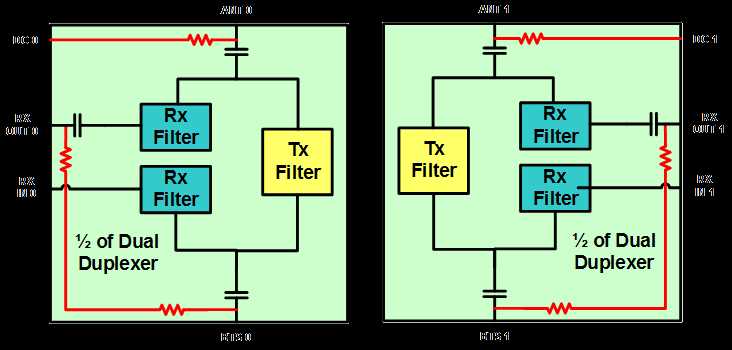
Use a frequency-selective switching network that routes the transmitter and receiver through shared antenna paths while maintaining isolation above 60–90 dB. Such an arrangement relies on narrowband resonant sections tuned precisely to the operating frequencies. In VHF and UHF installations, technicians usually apply quarter-wave resonators or compact cavity filters adjusted with threaded tuning screws. Maintain spacing between resonant elements and keep the interconnections shorter than λ/20 to reduce parasitic coupling.
A typical technical layout shows two filtering branches connected to a common antenna port. One branch passes the transmit band and rejects the receive band, while the second path performs the opposite task. Each branch may contain LC resonant stages, coaxial cavities, or microstrip filter sections etched on FR-4 or Rogers substrates. For handheld radio modules operating near 400–470 MHz, designers frequently select microstrip band-pass structures combined with notch traps tuned about 1–3 MHz away from the carrier to suppress leakage.
Component placement strongly affects performance. Keep inductors orthogonal to reduce magnetic coupling and place grounded shielding partitions between filter stages. Transmission lines linking resonators should maintain controlled impedance near 50 Ω. Simulation in RF tools such as harmonic balance analyzers allows verification of insertion loss below 1.5 dB and port isolation above 70 dB. Careful adjustment of trimmer capacitors or sliding plungers during measurement with a vector network analyzer produces the desired frequency separation while protecting the receiver front end from high-power transmit pulses.
Duplexer Circuit Diagram
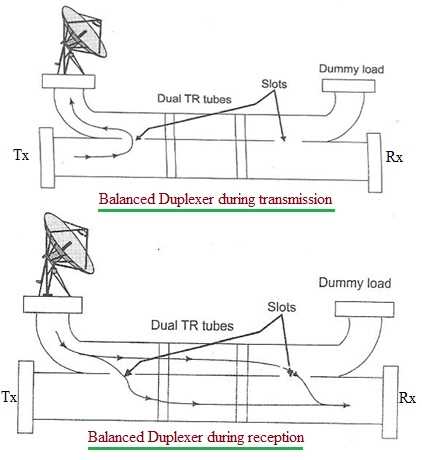
Place the transmit and receive paths on separate resonant branches tuned to their operating bands; for example, a 144 MHz transmitter and a 146 MHz receiver path can be isolated using two band-selective filter sections with ≥70 dB rejection at the opposite frequency. A practical RF layout uses quarter-wave coaxial resonators or LC filter networks connected through a shared antenna node. Maintain insertion loss below 1.2 dB in the transmit path to prevent power dissipation and signal compression in the receiver input.
A typical RF switching layout contains three ports: antenna, transmitter, and receiver. Between the antenna node and the transmitter port, install a band-pass filter centered on the transmit frequency. Between the antenna node and the receiver port, implement a narrow band-pass section tuned to the receive channel. For VHF systems around 150 MHz, resonant inductors in the range of 120–180 nH paired with capacitors between 6 pF and 15 pF produce stable selectivity. Shield each resonator with grounded partitions spaced about 8–12 mm apart to suppress parasitic coupling.
Isolation performance depends heavily on resonator Q-factor. Air-core coils wound with 1.2 mm copper wire often achieve Q values above 200 at VHF frequencies. Combine three or four resonant stages per branch to reach 80 dB transmitter suppression at the receiver port. Mechanical tuning screws positioned above the resonant cavities allow frequency trimming within ±1.5 MHz without replacing components.
Layout geometry affects performance as much as component values. Keep RF traces shorter than λ/20 of the operating wavelength; at 450 MHz this equals roughly 3 cm. Use ground planes on both PCB layers connected by vias spaced every 4–6 mm. Transmission lines designed for 50 Ω impedance should maintain a width of about 2.8–3.1 mm on standard FR-4 with 1.6 mm thickness.
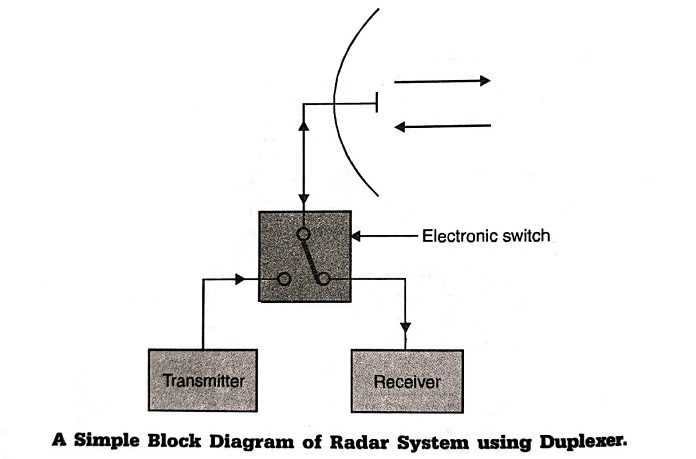
High-power transmitters require thermal and voltage tolerance analysis. At 50 W RF output, voltage peaks at the resonant nodes may exceed 120 V. Select capacitors rated for at least 200 V RF operation and with NP0/C0G dielectric to avoid drift. Coaxial cavity implementations often replace discrete components entirely; a λ/4 cavity at 430 MHz measures about 17 cm in length and offers narrower bandwidth with insertion loss near 0.5 dB.
Testing should include network analyzer measurements across both signal paths. Sweep the antenna-to-receiver channel and confirm passband ripple under 0.8 dB with bandwidth near 300 kHz for narrowband communication systems. Then measure transmitter leakage into the receiver port; acceptable installations usually show −75 dB or lower at the transmit frequency. Fine tuning is achieved by adjusting cavity screws or trimming capacitor values in steps of 0.5–1 pF.