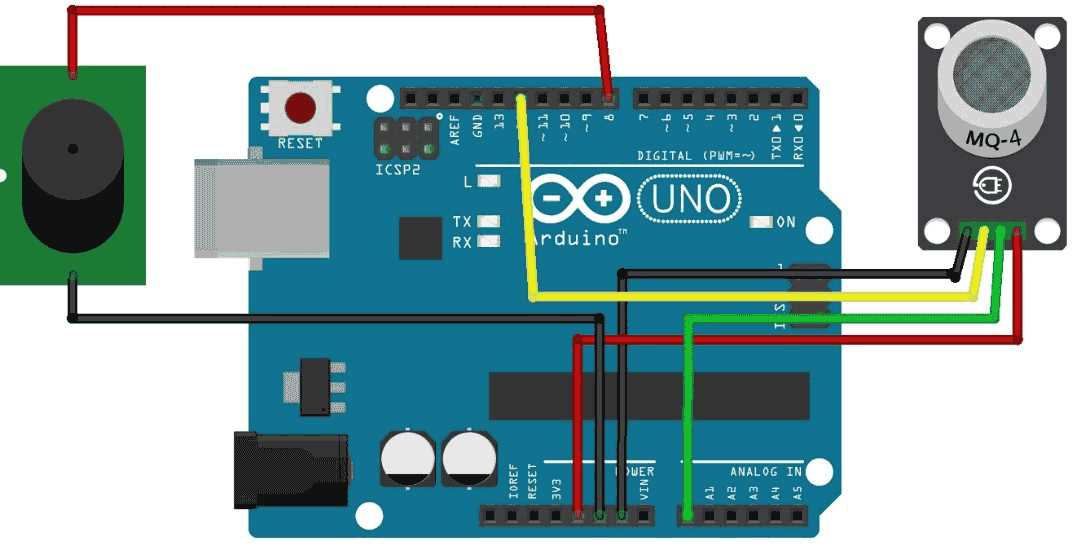
Connect the detection module through a voltage divider with a load resistor between 5 kΩ and 20 kΩ and supply the internal heater with a stable 5 V source capable of 150–200 mA. Semiconductor detection elements such as MQ-series devices change resistance depending on combustible or toxic vapor concentration. The output signal appears as a variable voltage that can be read by an analog input of a controller.
Most metal-oxide detectors contain a small heating coil that raises the sensing surface temperature to about 200–400 °C. The heater stabilizes the chemical reaction on the tin-oxide layer. Without this heating stage the resistance of the sensitive layer does not respond properly to methane, propane, carbon monoxide, or alcohol vapors.
The resistance of the sensitive element can vary from 200 Ω to over 10 kΩ depending on concentration levels. A simple measurement layout places the sensing element in series with a load resistor. The output voltage is taken from the midpoint and rises or falls as the resistance changes. Microcontrollers usually read this signal through a 10-bit or 12-bit ADC, producing digital values proportional to vapor concentration.
Stable readings require a warm-up period. Many MQ devices need 24 to 48 hours of initial heating before calibration. During operation the heating coil must remain powered continuously; switching it off leads to drift and inaccurate readings for several minutes after restart.
Shielded wiring and short signal paths help reduce interference. The analog output often ranges from 0.1 V to 4 V, which is sensitive to electrical noise produced by motors, switching regulators, or relays. Placing a small RC filter near the controller input, for example 100 Ω with 10 nF, smooths rapid fluctuations without slowing chemical response.
Calibration is performed using known concentration samples such as 1000 ppm methane or 300 ppm carbon monoxide. The measured voltage is mapped to resistance ratio values (Rs/Ro) and compared with manufacturer curves. This approach allows estimation of concentration levels across wide detection ranges used in leakage alarms, industrial monitoring units, and ventilation control systems.
Gas Sensor Circuit Diagram Wiring Heater Supply Signal Output and Controller Interface
Provide the metal-oxide detection element with a stable heater supply of 5 V at about 150–200 mA and route the sensitive layer through a load resistor between 5 kΩ and 20 kΩ. The output node forms a voltage divider where the measured voltage reflects resistance change caused by combustible or toxic vapors. Place the load resistor close to the detection element pins and keep the signal trace shorter than 10–15 cm to limit noise pickup before the analog input stage.
Feed the divider output directly to a microcontroller ADC input or through a simple buffer amplifier when cable length exceeds 30 cm. Typical signal range spans 0.2 V to 4 V depending on vapor concentration and chosen resistor value. Many controller boards use a 10-bit or 12-bit converter, producing 1024–4096 discrete levels suitable for leak monitoring and ventilation control. Add a small low-pass filter near the controller pin such as 100 Ω in series with 10 nF to ground; this suppresses switching noise from relays or power regulators without slowing chemical response. Warm-up time of the heated detection element usually exceeds 60 seconds after power application, while stable calibration conditions appear after several hours of continuous heating.
Gas Sensor Heater Power Supply and Load Resistor Wiring Layout
Provide the heating coil with a regulated 5 V supply capable of 150–200 mA and route the power path with thick traces or wires rated above 0.5 A. The internal heater keeps the tin-oxide surface between 200 °C and 400 °C, which allows chemical reactions with combustible vapors. Voltage fluctuation greater than ±0.1 V can shift the resistance of the sensing layer and distort concentration readings.
Place the heating element supply lines separately from the measurement path. Current pulses through the heater can introduce noise into the signal node if both paths share narrow tracks. A star grounding layout works well: the heater return and measurement return meet at a single ground point near the power connector.
The resistive detection element forms a voltage divider together with a load resistor. Choose this resistor within the range 5 kΩ to 20 kΩ depending on the expected concentration span. Lower values increase current flow and produce stronger voltage variation, while higher values reduce power consumption but shrink the measurable voltage swing.
Typical resistance of the sensitive layer ranges from 200 Ω in dense vapor conditions to more than 10 kΩ in clean air. With a 10 kΩ load resistor and a 5 V supply, the output node may vary roughly between 0.3 V and 4.5 V. This range fits most analog inputs on microcontroller boards powered by 5 V.
Keep the connection between the sensing element and the load resistor shorter than 20 cm. Long wires add parasitic resistance and pick up electromagnetic interference from motors, switching regulators, and relay coils. Twisted conductors reduce induced noise and stabilize the measurement node.
Install a decoupling capacitor near the heater supply pins. A 10 µF electrolytic capacitor combined with a 100 nF ceramic capacitor stabilizes voltage during current spikes produced by the heating coil. This arrangement maintains constant temperature of the sensitive surface and prevents drifting output readings.