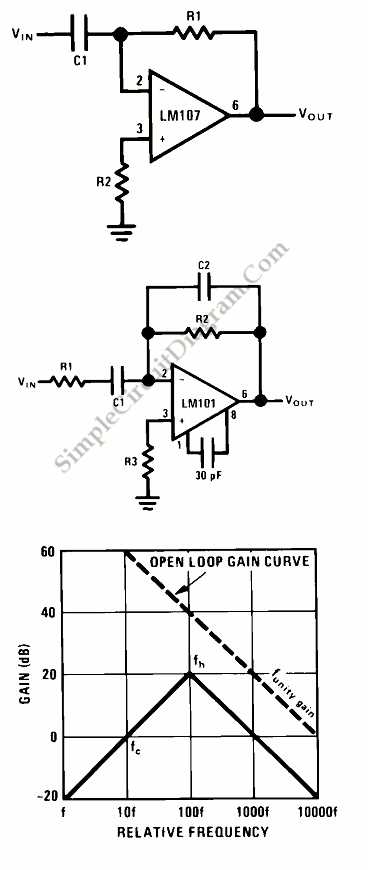
Choose precise resistor and capacitor values to control the rate at which voltage responds to changes in the input signal. Small deviations can significantly alter the output waveform.
Verify connections with a multimeter before applying power. Ensure that input and feedback paths are correctly oriented to prevent inversion errors and unwanted oscillations in the output.
Test response with a function generator by applying step or sine wave inputs. Measure the output with an oscilloscope to confirm that the signal slope corresponds to the input rate of change as expected.
Document all component values and layout positions for consistent reproduction and troubleshooting. Keeping a clear record allows you to replicate the setup or adjust parameters for different signal ranges without ambiguity.
Designing and Testing a Signal Differentiation Setup
Start by selecting resistor and capacitor values that match the desired response time. A higher resistor or capacitor increases the time constant, producing a slower voltage change at the output for the same input slope.
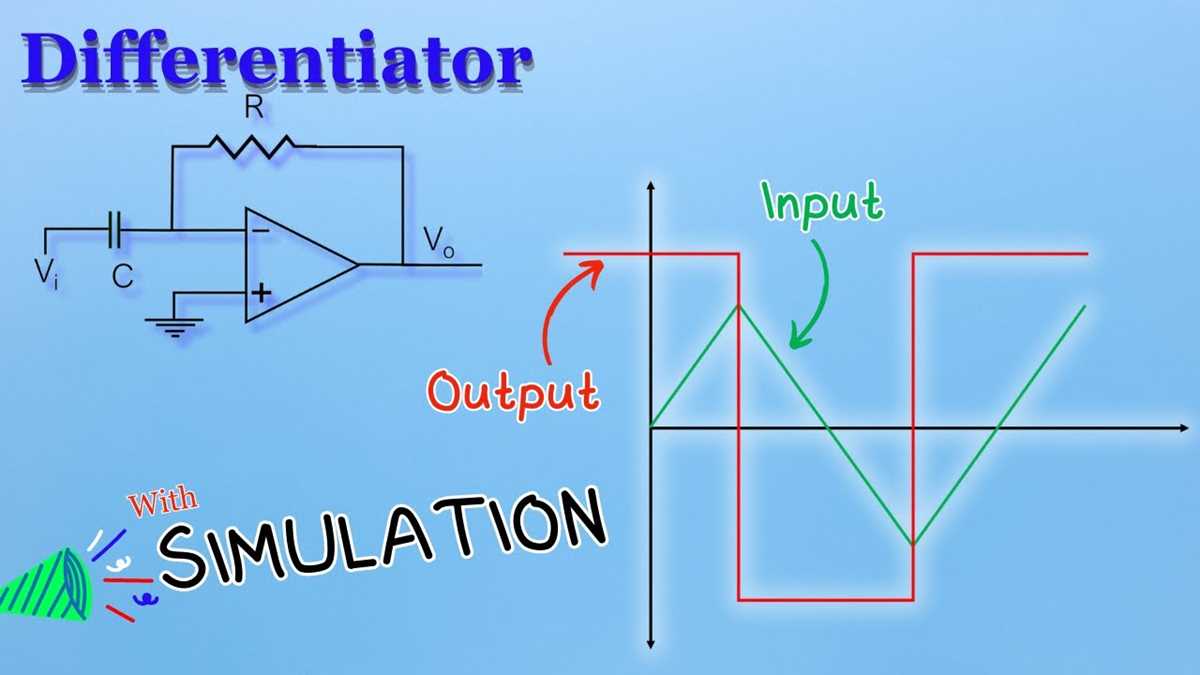
Place the capacitor at the input stage and connect the resistor to the output node. Ensure the orientation matches the intended signal path to prevent phase inversion or unexpected amplitude changes.
Use a breadboard for initial assembly. Check that all connections are secure, and avoid long unshielded wires which can introduce noise and distort the measured response.
Apply test signals using a function generator with step or sinusoidal inputs. Monitor the output on an oscilloscope to verify that the voltage rises and falls proportionally to the rate of change of the input signal.
Measure voltage drops across each component to confirm expected behavior. Small deviations can indicate faulty connections or components that do not meet their rated tolerance.
Document all values, layouts, and observed outputs for future reference. Keeping a detailed record allows modifications to achieve different response slopes or to reproduce the setup reliably for other signal ranges.
Selecting Resistors and Capacitors for Desired Output Response
Determine the target output slope by analyzing the rate of change required for your input signal. The combination of resistance and capacitance directly controls how quickly the voltage responds to variations.
Choosing Resistors
Select resistor values based on the desired time constant. Higher resistance slows the voltage change, while lower resistance allows faster response. Consider these factors:
- Power rating of the resistor to handle peak currents.
- Tolerance percentage for consistent behavior across devices.
- Temperature coefficient if the setup operates under varying environmental conditions.
Choosing Capacitors
Pick capacitor types that maintain stability at the expected frequencies. Options include:
- Ceramic capacitors for high-frequency response and minimal leakage.
- Electrolytic capacitors for larger capacitance values but slower response.
- Tantalum capacitors when size constraints require compact, reliable components.
Combine resistor and capacitor values to match the calculated time constant. Test several combinations to see which configuration produces the closest output slope to your design requirement.
Document all chosen components with exact values and tolerances. Record test results for each combination to replicate performance or adjust for different input ranges in future setups.