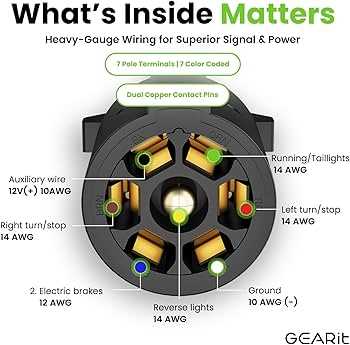
Ensure each terminal is correctly matched to its function to maintain safe power transfer and signal communication. Use a color-coded approach and verify connections against manufacturer charts to avoid misfires or shorts.
Check ground connections thoroughly since poor grounding can cause erratic lighting and trailer brake malfunctions. Inspect terminals for corrosion and secure each point with proper tightening tools.
Label all circuits clearly to distinguish turn signals, brake controls, reverse lights, and auxiliary power. Keeping track of individual lines reduces troubleshooting time and prevents accidental cross-connections.
Choose heavy-gauge conductors for circuits that handle higher current, such as brakes and auxiliary power. This minimizes voltage drop and protects against overheating during extended towing sessions.
Use dielectric grease on all contacts to prevent moisture infiltration and oxidation. Regular maintenance checks, especially before long trips, will preserve connectivity and extend the lifespan of the assembly.
Test the system methodically after installation using a multimeter or trailer tester. Verify each function independently and resolve any discrepancies immediately to ensure reliable operation on the road.
Complete Guide to Understanding and Installing a 7 Point Electrical Connector
Begin by identifying each terminal on the seven-point connector and matching it to its respective function. Labeling the cords before connecting prevents confusion and avoids potential shorts. Standard colors usually indicate turn signals, brakes, tail lights, and auxiliary power. Using a multimeter to verify continuity can save time and prevent misconfigurations.
Ensure all contacts are free of corrosion and debris before attaching the leads. Applying a small amount of dielectric grease enhances conductivity and protects against moisture. Secure each pin firmly in its slot, confirming that retention clips lock in place to avoid intermittent contact during movement or vibration.
Testing and Verification
After connections are made, perform a systematic check by activating each function individually. Observe the corresponding indicator on the towing vehicle and trailer to confirm proper operation. If a circuit fails, retrace connections, testing each pin with a continuity meter to pinpoint the issue without disturbing other circuits.
For long-term reliability, periodically inspect the connector for loose wires, oxidation, or wear. Tighten screws and clean contacts when necessary. Storing the assembly in a protective cover when not in use prolongs lifespan and maintains consistent performance, ensuring safe and dependable operation on every trip.
Identifying Each Wire Function in a 7 Blade Trailer Connector
Start by labeling each conductor according to its role to prevent misconnection. Typically, the central pin handles the ground, ensuring a stable return path. The adjacent pins manage turn signals, brake lights, and tail lamps, with distinct colors assigned for easy recognition: green for right turn, yellow for left turn, brown for running lights. The remaining wires often provide reverse signal and auxiliary power, which can be confirmed using a multimeter before final connection.
Follow a step-by-step verification process:
- Connect the ground to the vehicle chassis and test continuity to the trailer frame.
- Activate each light function separately and confirm the correct conductor responds.
- Mark wires with heat-shrink labels or numbered tags for future maintenance.
- Inspect for corrosion or loose terminals that could disrupt the circuit.
- Secure all conductors to prevent strain during movement.