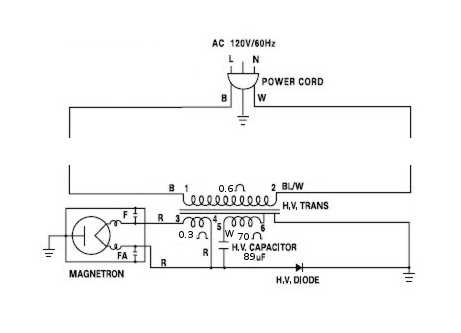
Disconnect the appliance from the mains supply and discharge the high-voltage capacitor before examining the internal electrical layout. Inside this kitchen heating unit the power stage can reach 2000–4000 volts, produced by a step-up transformer feeding a magnetron tube through a diode and capacitor network. Direct contact with stored charge may cause severe injury.
The energy path begins at the AC input line, which passes through a fuse, thermal cutoff, and door interlock switches before reaching the main transformer. That transformer raises household voltage from 120 V or 230 V to a high-voltage output typically above 2000 V AC. A rectifier diode and capacitor convert this into a high-voltage DC supply that powers the magnetron, the component responsible for generating microwave radiation used for food heating.
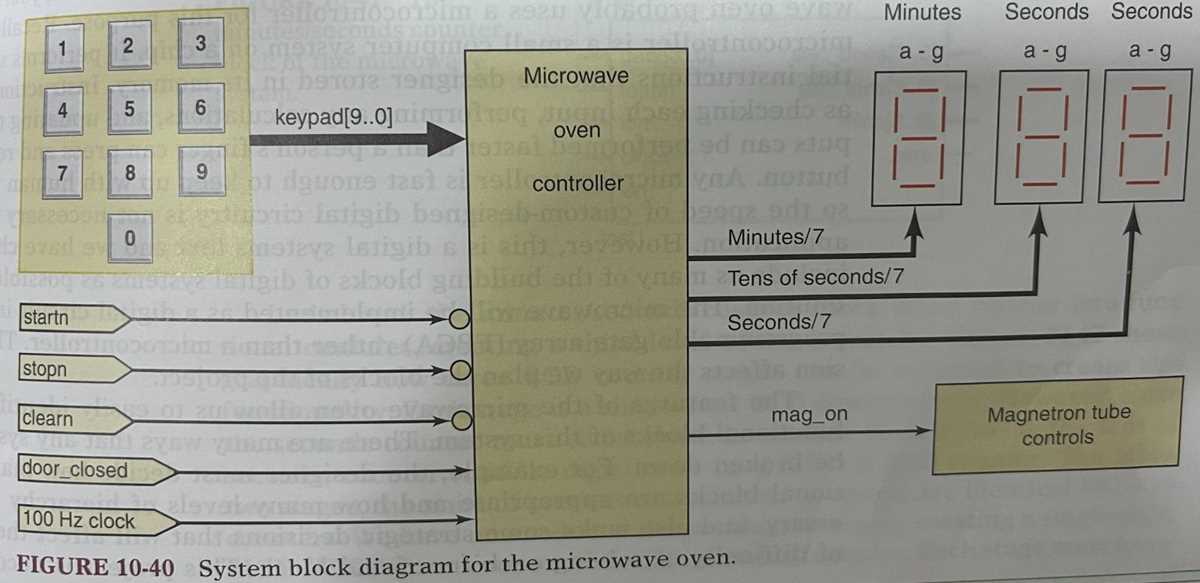
The control section manages timing, relay switching, and safety monitoring. Mechanical timer models rely on rotary switches and relays, while digital versions use a small control board with a microcontroller, keypad interface, and display driver. This board activates relays that route mains power to the transformer, cooling fan, turntable motor, and internal lamp.
Door interlock switches play a safety role by cutting the power path when the door is open. Most units include two or three switches connected in series with the power line. If one switch fails, the design forces a fuse blow or prevents magnetron activation, stopping radiation emission while the door is not fully closed.
Cooling airflow also connects to the electrical layout. A fan motor runs whenever the heating stage operates, pushing air across the magnetron fins and high-voltage transformer. Typical fan motors draw 15–40 watts, while the magnetron consumes 600–1200 watts depending on the appliance rating.
Tracing each connection path helps identify common faults such as blown fuses, failed high-voltage diodes, open thermal cutoffs, or relay contacts stuck in the open position. Careful measurement with an insulated multimeter and capacitor discharge tool allows safe verification of each component within the internal power network.
Microwave Oven Circuit Diagram Showing Magnetron Transformer and Control Board
Disconnect the appliance from mains power and discharge the high-voltage capacitor before inspecting the internal electrical layout. The heating unit contains a power stage that produces more than 2000–4000 V, generated by a step-up transformer that feeds the magnetron tube through a diode and capacitor assembly.
The energy path begins at the AC input line. Current flows through a fuse, thermal cutoff, and several door interlock switches before reaching the heavy high-voltage transformer. This transformer raises the household supply from 120 V or 230 V to a secondary output around 2000 V AC. A high-voltage rectifier diode and capacitor convert this output into pulsating DC that powers the magnetron cathode and anode system.
The magnetron converts electrical power into microwave radiation used for heating food. Typical magnetron units operate near 2.45 GHz and consume between 600 and 1200 watts depending on appliance rating. Cooling airflow from a fan motor passes across the magnetron fins and transformer body to prevent overheating.
The control board manages switching operations. Digital models include a small microcontroller board connected to a keypad, display module, and relay drivers. When a cooking program is selected, the controller energizes a relay that routes mains voltage toward the high-voltage transformer while also powering the cooling fan, turntable motor, and interior lamp.
Door safety switches are placed in series with the power path. Many units include two interlock switches plus a monitor switch. If the door opens during operation, the switch contacts interrupt the supply line immediately, cutting power to the transformer and stopping magnetron activity.
Component placement inside the chassis usually follows a fixed layout: transformer mounted near the base plate, capacitor and diode close to the magnetron terminals, and the control board located behind the front panel. Following each connection path within this electrical schematic helps locate faults such as blown fuses, defective relays, open thermal cutoffs, or failed high-voltage diodes.
Microwave Oven Circuit Diagram With Magnetron High Voltage Transformer Capacitor and Diode Connections
Disconnect the appliance from mains power and discharge the high-voltage capacitor before tracing the internal electrical layout. The heating system relies on a step-up transformer that raises input voltage from 120 V or 230 V to approximately 2000–2200 V AC. One side of the secondary winding connects directly to the magnetron cathode. The other side feeds a high-voltage diode and a large capacitor rated around 0.8–1.1 µF at 2100–2500 VAC. This arrangement forms a voltage doubler that produces more than 4000 V DC, required for magnetron operation.
The magnetron anode connects to the metal chassis while the filament receives power from a separate low-voltage winding on the transformer, usually around 3.3 V at high current. The high-voltage diode conducts during one half of the AC cycle, charging the capacitor; during the opposite half cycle the stored energy combines with the transformer output, doubling the voltage applied across the magnetron terminals. This configuration allows a compact power stage capable of delivering 600–1200 W of microwave output used for food heating.