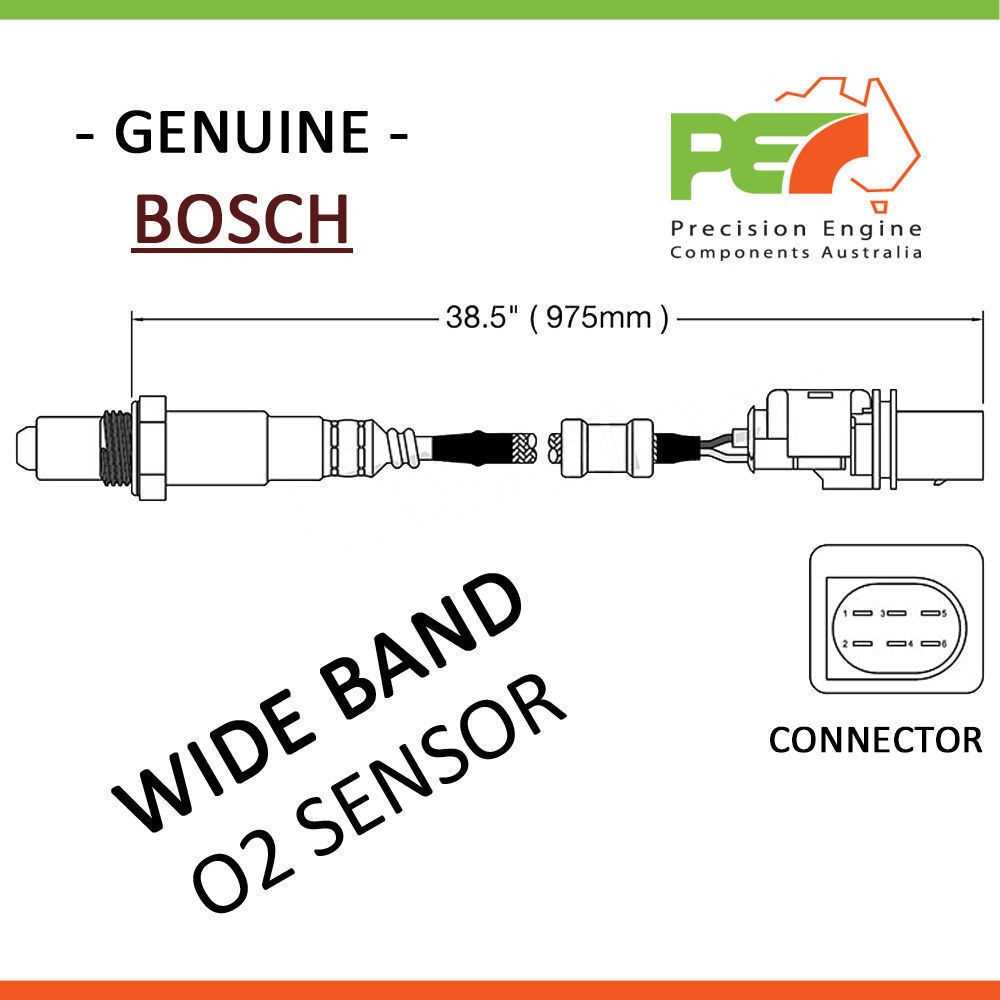
Connect the heater supply lead from the vehicle harness to a 12-volt ignition powered line and attach the heater return lead to chassis ground. These two conductors feed the internal heating element that brings the exhaust gas probe to operating temperature of about 350–400°C within seconds after engine start.
The remaining two leads carry measurement data and reference ground to the engine control module. The signal path usually outputs a fluctuating voltage between 0.1 V and 0.9 V. Low voltage indicates a lean air-fuel mixture, while values closer to 0.9 V indicate a rich mixture during combustion.
Manufacturers often use similar insulation colors for the heater pair. Two white leads frequently feed the heating element, while black carries the measurement output and gray acts as reference ground. Always confirm the color mapping in the vehicle service manual because variations exist across brands.
Measure heater resistance with a multimeter before installation. A typical heating element inside this exhaust gas probe shows 5–14 ohms depending on model. Infinite resistance indicates a burned heater, while very low resistance may point to an internal short.
Route the harness away from exhaust pipes and moving drivetrain components. Use high-temperature sleeving where the cable passes within 10–15 cm of the exhaust manifold. Proper routing protects insulation and keeps the exhaust gas measurement signal stable during engine operation.
4 Wire Oxygen Sensor Wiring Diagram With Heater Power Signal and Ground Layout
Connect the heating element supply line to a 12 V ignition-controlled source and attach the heater return line to chassis ground. This internal heater raises the exhaust gas probe temperature to operating range above 350°C, which allows accurate mixture feedback shortly after engine startup.
The assembly contains four conductors grouped into two functional pairs. One pair powers the heating element while the second pair carries measurement output and reference ground to the engine control module.
Typical lead color identification
- Two white leads – heating element power and return
- Black lead – exhaust gas measurement signal
- Gray lead – signal ground reference
Voltage from the measurement lead fluctuates between 0.1 V and 0.9 V. Values near 0.1 V indicate lean combustion, while readings close to 0.9 V indicate rich fuel mixture. The control module constantly adjusts fuel injection according to these changes.
Check heater resistance before installation using a digital multimeter. Typical values range from 5 Ω to 14 Ω. A reading far above this range suggests an open heating element, while extremely low resistance may indicate internal damage.
Basic connection layout
- Ignition powered 12 V line connected to heater supply lead
- Heater return lead attached to engine ground
- Signal output lead routed to engine control module input
- Signal ground connected to ECU reference ground
Route the harness away from exhaust headers and rotating drivetrain components. Maintain at least 10–15 cm clearance from high temperature surfaces or use fiberglass heat sleeve where close routing cannot be avoided.
Secure the harness with heat-resistant clips and avoid sharp bends near the probe body. Stable connections maintain accurate exhaust gas readings and stable fuel control during engine operation.
4 wire oxygen sensor pinout and color code identification for heater and signal lines
Identify the heating element pair first. In most exhaust gas probes with four leads, the heater uses two white conductors. These two lines connect to a 12-volt ignition powered supply and chassis ground. Polarity usually does not matter for the heating element because it acts as a resistive load.
The remaining two leads carry measurement data and reference ground. A black conductor typically transmits the exhaust mixture signal to the engine control module, while a gray conductor acts as the reference return path. This pair allows the control unit to read voltage that fluctuates between 0.1 V and 0.9 V depending on combustion conditions.
Check pin positions at the vehicle harness plug before making connections. Hold the connector with the locking tab facing upward and note terminal positions from left to right. Heater pair often occupies the outer pins, while the signal path and reference return sit in the center. Confirm mapping with a multimeter by measuring resistance between the heater terminals; readings near 5–14 Ω indicate the correct pair.