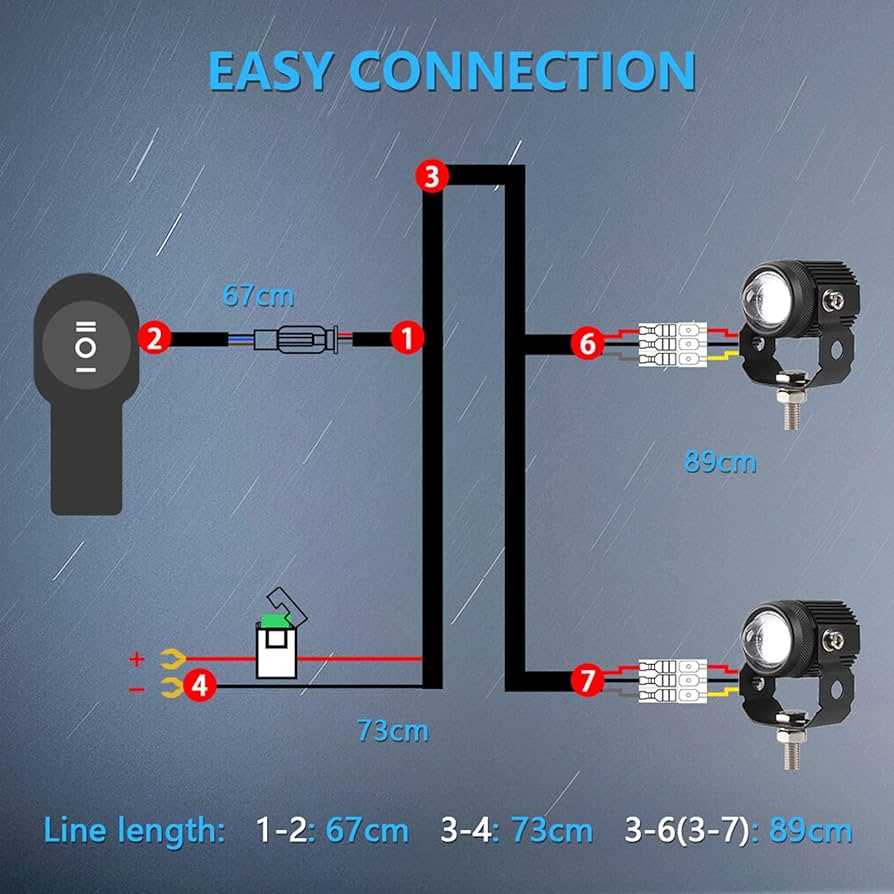
Connect the positive lead from the vehicle battery to a fused relay terminal and route the output from that relay to the auxiliary driving lamps mounted in the bumper or grille area. The third conductor runs from the dashboard switch to the relay control terminal, allowing the driver to activate the lamps without sending high current through the switch.
Most vehicles operate on a 12-volt electrical system, and a pair of auxiliary road lamps typically draws 6–10 amps combined depending on bulb type. Halogen units rated at 55 W each require thicker conductors such as 14 AWG. Systems using LED modules often consume less than 3 amps per unit, though relay control is still recommended for stable operation.
Install a fuse between the battery positive terminal and the relay supply point. The fuse rating should exceed the normal load but remain close enough to protect the harness, commonly 10–15 A for two halogen lamps. Ground connections should attach to bare metal on the chassis with a clean contact surface and a ring terminal tightened securely.
A clear connection layout helps avoid reversed polarity or constant lamp operation. Using a relay isolates the dashboard switch from high current and keeps voltage drop low along the supply path. During testing, a multimeter should show 12–13 V at the lamp input when the switch is activated and near zero volts when the switch is off.
3 Wire Fog Light Wiring Diagram with Relay Switch and Power Connections
Run a power lead from the vehicle battery to terminal 30 of the relay through an inline fuse rated between 10 and 15 amps. From relay terminal 87 route the supply line to the pair of auxiliary road lamps mounted at the front bumper. Ground the lamp housings to a clean chassis point using ring terminals and bolts tightened against bare metal.
Control of the relay uses a low-current path connected to the dashboard switch. One conductor from the switch feeds relay terminal 86, while terminal 85 connects to chassis ground. When the switch is pressed, current flows through the relay coil and closes the internal contact between terminals 30 and 87, allowing battery voltage to reach the lamps without routing high current through the dashboard control.
Choose conductor size based on lamp load. Two halogen units rated at 55 W each draw roughly 9–10 A at 12 V, so 14 AWG copper is suitable for the supply path. LED modules usually consume less than 3 A per unit, though the relay layout still helps maintain stable voltage at the lamp input and prevents overheating of the cabin switch.
3 Wire Fog Light Wiring Diagram with Power Ground and Switch Terminals

Connect the battery positive lead to the supply terminal of the auxiliary lamp circuit through an inline fuse rated between 10–15 A. Route the output conductor from this supply point to the front-mounted road lamps. Attach the return path from each lamp housing to a clean chassis point using ring terminals and bolts tightened against bare metal.
Use the dashboard control to manage lamp activation. The switch connects the control line between the battery supply and the relay trigger terminal. This arrangement allows a low-current signal to activate the relay while the heavier current feeding the lamps travels through the relay contacts rather than through the cabin switch.
Typical connection roles:
- Power lead from battery through fuse to relay input
- Ground return from lamp housing to chassis metal
- Switch control conductor linking dashboard switch to relay trigger terminal